
🍓 ThirdSpace BUZZ: Tracking Financial Crime in the Modern Music Industry
From analog payola to AI-driven royalty fraud, how the music business is being weaponized to wash dirty money.
ThirdSpace BUZZ is an edgy newsletter on whatever the fuck I want.
The music industry feels like a world of art, emotion, and ephemeral trends. Behind the glitz of festival stages and the seamless experience of a streaming playlist, however, lies a complex, multi-layered financial infrastructure.
Because this industry trades in the subjective—where the value of a song or a tour is often whatever someone is willing to pay for it—it has become a prime target for illicit financial activity.
Money laundering here isn’t about secret handshakes or cryptic symbols; it’s about exploiting the blurry lines between high-art prestige and high-stakes capital.
Let’s peel back the curtain on the millions of dollars in the shadows.
🍓

Sponsored by:
Help us grow by sponsoring our newsletter and reaching an engaged community.

“The music business is a cruel and shallow money trench, a long plastic hallway where thieves and pimps run free, and good men die like dogs. There’s also a negative side.”
— Hunter S. Thompson

🍓 The Invisible Rhythm

Money laundering is effectively a process of obfuscation. To integrate dirty money into the formal economy, a criminal needs a vehicle that moves cash and generates a paper trail that looks like legitimate business income. The music industry provides three specific pillars for this: anonymity, subjectivity, and volume.
1. The Power of Intangibles
Unlike selling a house or a physical car, selling a song’s publishing rights involves valuing an asset that exists primarily in the ether. If a shell company buys a small, unknown music catalog for $5 million, who is to say it’s actually worth only $50,000? This subjectivity allows for the movement of massive amounts of capital under the guise of an “investment” or “royalty purchase.” By layering these transactions through offshore entities, the original source of the money vanishes behind a professional-looking contract.
2. The Streaming Mirage
The rise of digital streaming has introduced a new, technological frontier for laundering. We’ve seen the emergence of “bot farms”—sophisticated networks of thousands of devices programmed to play specific tracks on repeat. When a criminal controls the song, the bot, and the distribution platform, they can effectively pay themselves. By feeding illicit cash into the bot-farm operation, they create a stream of legitimate royalty payments flowing back into their accounts. It is essentially a digital washing machine, converting dirty money into “earned” creative income.
Echoes of the Past: Notable Lessons in Greed
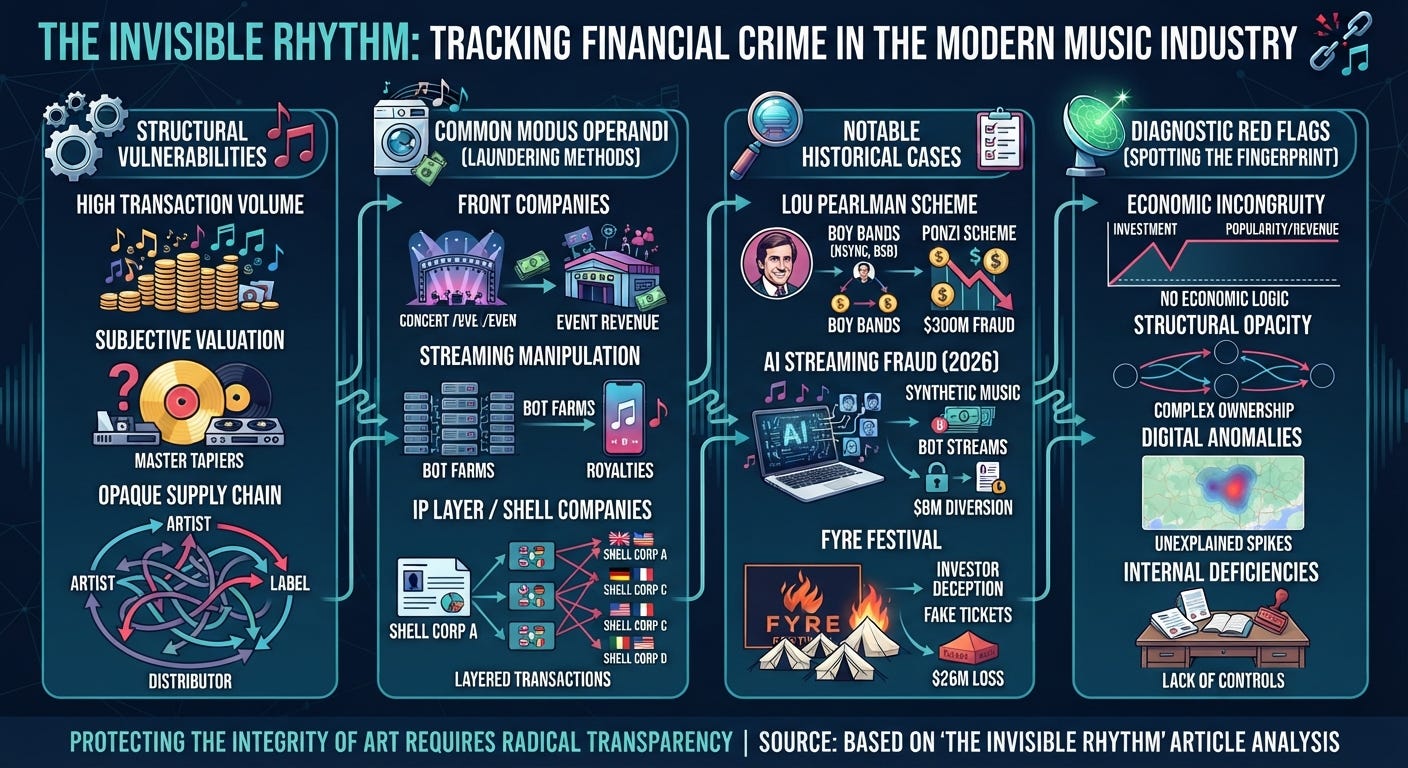
History provides a roadmap of how these schemes evolve. The case of Lou Pearlman remains the industry’s most infamous intersection of celebrity and criminality. While he was crafting the golden era of boy bands, he was simultaneously orchestrating a $300 million Ponzi scheme.
He used his fame as a producer—the very real success of NSYNC and the Backstreet Boys—as a smoke screen. Investors didn’t look too closely at his fake airline companies because they were blinded by the glitter of his music empire.
Fast-forwarding to 2026, we see the shift toward automation. The case of Michael Smith, who was recently convicted for orchestrating an AI-driven streaming fraud scheme, highlights the modern evolution. Smith wasn’t selling boy bands; he was selling scale.
By using AI to flood platforms with synthetic tracks and bots to boost them, he diverted over $8 million that should have gone to working musicians. This is the new reality: the crime has moved from the boardroom to the server room.
Spotting the “Fingerprint” of Fraud
If you are working in the industry, or simply observing it, how do you distinguish between organic success and a manufactured front? The answer lies in the data.
The Velocity Gap: Real success has a specific rhythm. It grows through social media mentions, concert ticket sales, and radio airplay. If a song has 50 million streams but no comments, no shared videos, and no touring history, you aren’t looking at a hit; you are looking at a manipulation.
The Corporate Web: Legitimate labels and publishers have a clear structure. If you find yourself dealing with an entity that has no physical office, no clear staff, and routes payments through four different countries before hitting your account, ask yourself: Why? Transparency is the enemy of the launderer.
The “Guaranteed” Promise: Professionals in the music industry know that “guaranteed success” is a lie. If an investor promises you massive growth in exchange for an upfront fee or a “marketing package” that feels like a black box, the probability of financial exploitation is extremely high.
The Regulatory Horizon
Governments are starting to catch up. Increased scrutiny on royalty distributions and the implementation of stricter KYC (Know Your Customer) requirements for digital music distributors are helping to tighten the net. Yet, as the law tightens, the criminals adapt. They move to newer, more obscure corners of the creator economy, such as NFT-based royalties or decentralized fan-funding platforms, where oversight is currently minimal.
A Call for Transparency
The music industry thrives on the passion of its creators. Unfortunately, that same passion is often used to lower our defenses. Protecting the integrity of the industry requires a collective shift toward radical transparency.
We must move away from the idea that “the music business” is a magical, mysterious world that plays by its own rules. It is a business, and like any other business, it should be subject to audit, oversight, and a demand for legitimacy.
By holding the industry to these standards, we don’t just protect the money; we protect the art from being treated as nothing more than a tool for a financial crime.

Help us grow by advertising your business in our newsletter and reaching an engaged community.
