
🍋 ThirdSpace BUZZ: The Life and Times of Henry Hill: Inside the Lucchese Syndicate
A descent into the underworld: From neighborhood errand boy to federal informant.
ThirdSpace BUZZ is an edgy newsletter on whatever the fuck I want.
Henry Hill Jr. (June 11, 1943 – June 12, 2012) stands as one of the most enigmatic figures in the history of American organized crime.
Neither a “made man” nor a high-ranking boss, he was nonetheless the quintessential mob associate—the engine room of the Lucchese crime family’s illicit operations for over two decades.
His transformation from a Brooklyn teenager running errands for local wise guys to an FBI informant whose testimony dismantled criminal enterprises remains a seminal case study in the dynamics of the Italian-American Mafia.
🍋

Sponsored by:
Help us grow by sponsoring our newsletter and reaching an engaged community.

“To me, being a gangster was better than being president of the United States.”
— Henry Hill

🍋 The Education of a Mob Associate
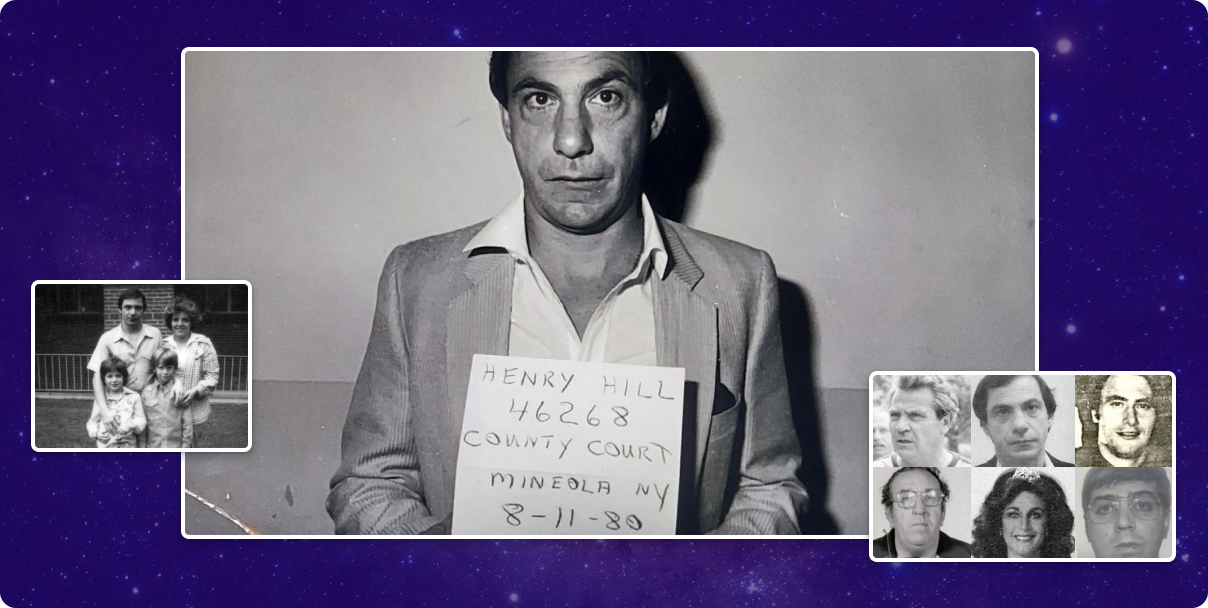
Born in Brownsville, Brooklyn, to an Irish-American father and a Sicilian mother, Hill grew up in the shadow of the Lucchese crime family. His initiation into the world of crime was not through violence, but through the mundane: serving drinks and sandwiches at a card game run by Paul Vario. It was here, at the tender age of thirteen, that he met James “Jimmy the Gent” Burke. Burke, a ruthless hijacker and Lucchese associate, recognized something in the young, dyslexic boy—a willingness to operate within the shadows and a knack for avoiding the law.
Hill’s early career was built on the back of “no-show” jobs and construction scams facilitated by the Vario crew. He quickly learned the unspoken rules of the underworld: profit is the ultimate objective, and cooperation with the authorities is the ultimate sin. His first arrest, at age sixteen for using a stolen credit card, served as a rite of passage. By refusing to implicate his superiors, he earned their trust, solidifying his status as a reliable operative.
The High Life and the Heavy Price
Hill’s criminal life reached its apex in the 1960s and 70s. His involvement in the Air France robbery of 1967, which netted $420,000, marked his transition from a low-level associate to a significant earner within the Vario crew. The spoils of his illicit activities allowed him to live a life of ostentatious luxury, characterized by nightclubs like the Copacabana and a level of influence that local law enforcement found nearly impossible to penetrate.
However, the camaraderie of the mob was built on a foundation of shifting loyalties and brutal violence. The murder of William “Billy Batts” Bentvena in 1970 serves as a gruesome illustration of the casual cruelty inherent in this lifestyle. Following a trivial insult directed at Tommy DeSimone, Hill and his associates beat Bentvena before ultimately disposing of his body. The incident highlighted the fragility of life within the hierarchy: respect was earned through intimidation, and any perceived slight could lead to a shallow grave.
The Collapse: Drugs and the Informant’s Path
Despite the strict prohibitions against narcotics trafficking within the Lucchese family, Hill’s greed led him into the drug trade following his release from prison in 1978. While he made significant sums of money, the enterprise exposed him to the scrutiny of federal agents. Wiretapped conversations, often obscured by bizarre, coded language about “dogs” and “golf clubs,” ultimately provided the evidence needed to break his operation.
In 1980, the facade finally crumbled. Facing a lengthy prison sentence, Hill opted for self-preservation over the omertà code. He turned informant for the FBI, providing testimony that led to fifty convictions, including those of Paul Vario and James Burke.
A Legacy of Infamy
Henry Hill’s life is best encapsulated by his own perspective on his choices:
“To me, being a gangster was better than being president of the United States.”
This sentiment, famously captured in Nicholas Pileggi’s Wiseguy and immortalized in Martin Scorsese’s Goodfellas, underscores the profound psychological allure of the criminal life. Even after entering the Witness Protection Program, Hill struggled to adapt to the mundane reality of civilian life, eventually being removed from the program in 1987 due to his inability to break old habits and maintain a low profile.
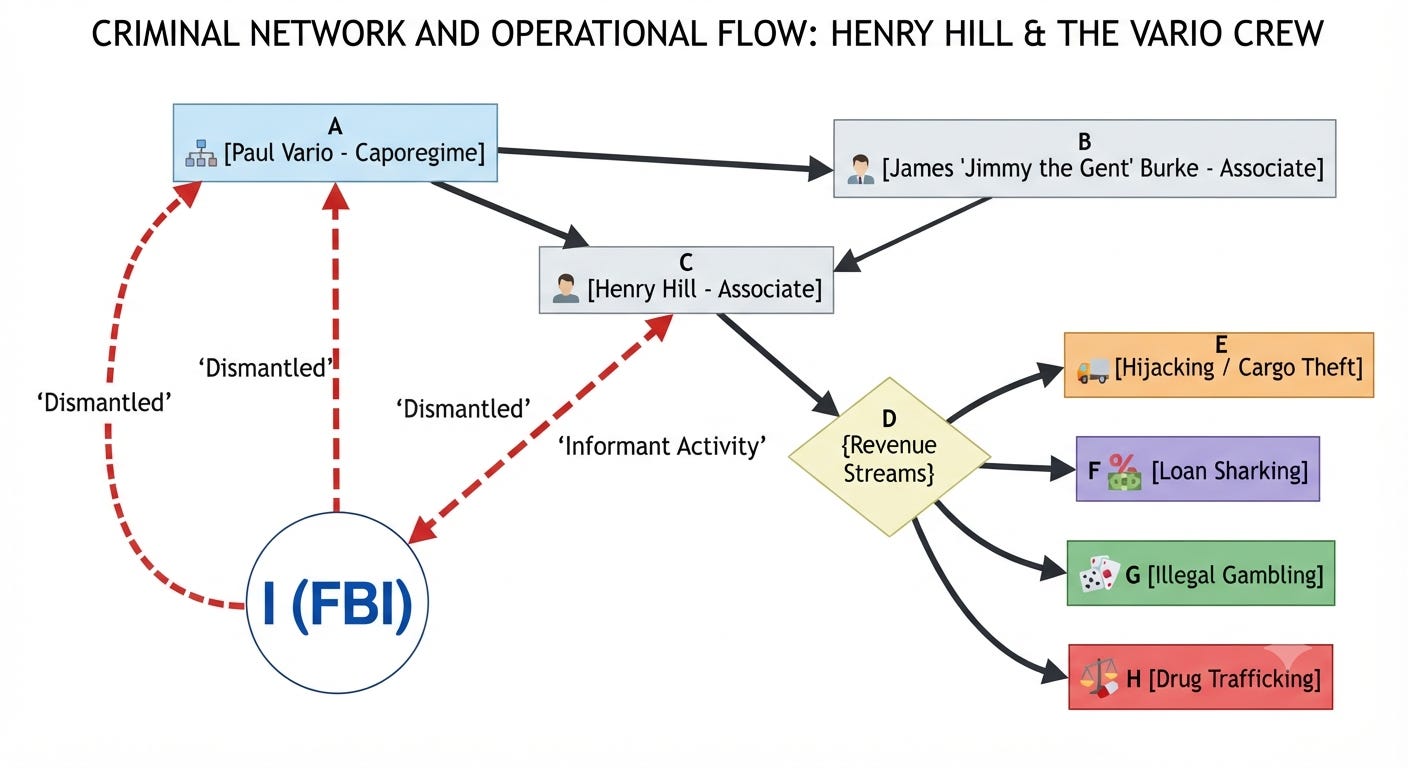
Visualizing the Syndicate: A Flow of Operations
The following diagram illustrates the interconnected, albeit unstable, structure of the crew Hill operated within, highlighting the flow of influence and illicit gain:
The End of the Line
Hill spent the latter decades of his life as a minor celebrity, appearing on talk shows, writing books, and even opening restaurants, attempting to monetize his notoriety. His death in 2012 in Los Angeles marked the conclusion of a life spent navigating the dangerous intersection of power, greed, and eventual redemption—or perhaps, simply, survival.
His story remains a cautionary tale of the Mafia’s internal rot. By prioritizing short-term gain over the long-term integrity of their organization, men like Hill and his associates ensured their own destruction. While pop culture has often romanticized the lifestyle Hill led, the reality was a fractured world where family was a concept, not a practice, and where the only certainty was that the next betrayer was likely sitting across the table.

Help us grow by advertising your business in our newsletter and reaching an engaged community.
