
ThirdSpace BUZZ is an edgy newsletter on whatever the fuck I want.
Behind the constant noise of breaking news lies a carefully engineered global architecture where central banks and institutional market makers dictate liquidity.
Rather than simple economic randomness, sudden market panics and volatile headline surges serve as algorithmic execution catalysts.
Understanding how sovereign debt, derivatives, and international enclaves interlock reveals the true operational blueprint of modern global financial control, transforming chaotic everyday market signals directly into a profound structural clarity.
🕵️

Sponsored by:
Help us grow by sponsoring our newsletter and reaching an engaged community.

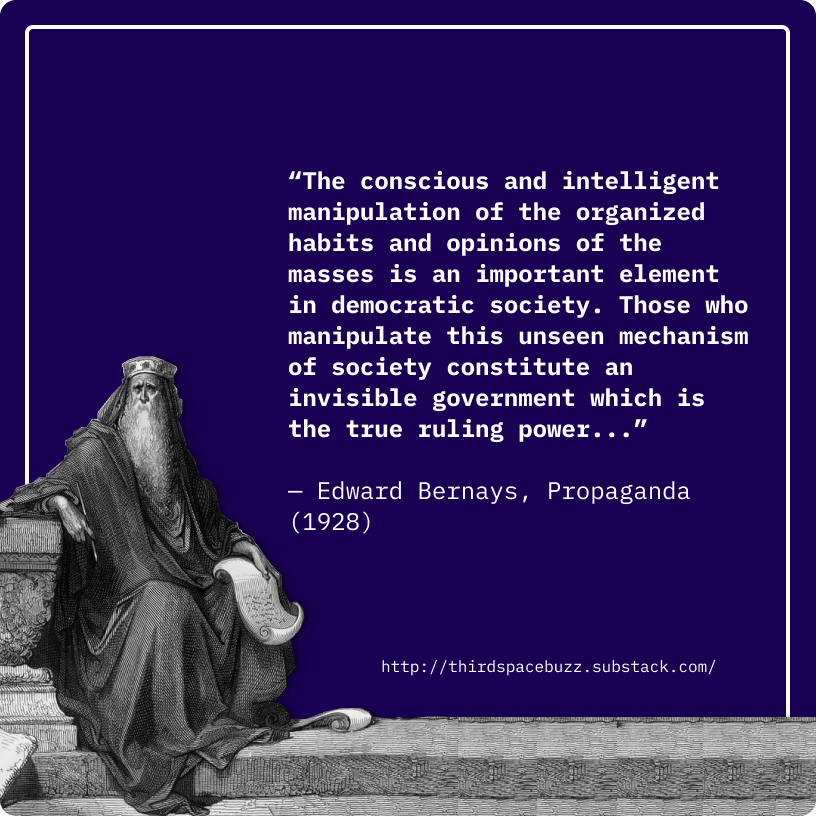
“The conscious and intelligent manipulation of the organized habits and opinions of the masses is an important element in democratic society. Those who manipulate this unseen mechanism of society constitute an invisible government which is the true ruling power...”
— Edward Bernays, Propaganda (1928)

🕵️ Macro Headlines, Sovereign Enclaves, and Algorithmic Liquidity Drive Global Control
To navigate the modern economic landscape, one must look beyond surface-level financial commentary and examine the mechanical machinery running underneath. Today’s global markets operate not as free-floating auctions of supply and demand, but as highly sophisticated, algorithmically mediated distribution networks where sovereign power, institutional leverage, and headline narratives intersect to manage global liquidity and human behavior.
The Macro Narrative Matrix and Algorithms
Modern financial headlines do not reflect isolated economic developments. Keywords such as Yen Carry Trade, US Debt $40T, Diesel Crack Spread, Strait of Hormuz, Copper Shortage, and AI Bubble form an interconnected macro narrative matrix. In fragile market environments—characterized by high debt, thin liquidity, and heavy options positioning—these headlines act as execution catalysts for institutional capital.
Natural Language Processing and Front-Running
High-frequency trading (HFT) algorithms utilize Natural Language Processing (NLP) engines to parse wire services, social feeds, and regulatory filings within microseconds. Upon detecting specific phrase combinations, execution scripts enter orders before human market participants can react. These automated bursts push price directly into pre-placed institutional liquidity blocks.
Liquidity Harvesting and Stop Sweeps
Market makers maintain complete visibility over resting order books, including retail stop-loss concentrations and option strike walls. Macro headlines provide the high-volume narrative cover required to sweep these liquidity pools. By driving price through key technical levels, algorithms trigger forced retail liquidations, allowing institutional desks to absorb massive volume on the opposite side of the trade.
Market Architecture and Dealer Mechanics
The financial system operates as a multi-layered liquidity distribution network divided between lit public exchanges and unlit off-exchange venues.
Order Segmentation and Dark Pools
Over 40% of daily equity volume is processed off-exchange. Retail orders are purchased by wholesale market makers via Payment for Order Flow (PFOF) and executed within internal dark pools. Because retail flow is uncoordinated and non-directional (”non-toxic”), internalizers absorb it to capture the bid-ask spread with minimal risk. Conversely, “toxic” directional flow from institutional participants is routed to lit venues (e.g., CME, NASDAQ), where it directly drives public price discovery.
Dealer Gamma Positioning and Dynamic Hedging
Market makers maintain net-neutral risk profiles through dynamic options hedging. When market makers sell options to retail or institutional traders, they must continuously buy or sell underlying futures to maintain a zero-delta balance:
Long Gamma Regimes: Dealers own options contracts. As the underlying price drops, dealers buy; as it rises, they sell. This dampens market volatility.
Short Gamma Regimes: Dealers are short options contracts. As prices fall, dealers are forced to sell into the decline; as prices rise, they must buy into the rally. This mechanical feedback loop accelerates violent market squeezes.
The Sovereign Debt Leverage Engine
Sovereign bond markets represent the core collateral base of the global financial system. Hedge funds exploit fractional pricing discrepancies between cash US Treasuries and Treasury futures through the Treasury Basis Trade. Funds leverage their capital up to 50-to-1 by borrowing cash in the overnight Repurchase Agreement (Repo) market using Treasuries as collateral.
When repo rates spike or dealer balance sheets tighten, funds face instant margin calls, forcing rapid liquidations of cash Treasuries. This dynamic distorts yield curves and transmits volatility into FX, commodity, and equity markets.
Influencers, Prop Firms, and Derivatives
Retail engagement is systematically monetized through a pipeline that aggregates dispersed individual capital into predictable, actionable order flow.
Social Media Influencers as Order Flow Aggregators
Financial influencers, chartists, and alert group leaders function as unpaid marketing channels and order aggregators for institutional desks. Influencers focus thousands of retail traders onto specific tickers or option strikes, generating non-toxic order flow that brokerages sell to wholesale market makers.
During distribution phases, influencers broadcast bullish breakouts. The resulting surge in retail market-buy orders provides the necessary volume for institutions to offload large positions without crashing the market price. Quantitative funds scrape social feeds using sentiment-analysis algorithms to front-run anticipated retail buying waves.
Online Proprietary Trading Firms
Modern online prop trading firms (evaluation and challenge platforms) operate primarily on a B-Book simulation model. Up to 90% of retail applicants fail evaluation challenges due to rigid risk parameters. Payouts for the minority of successful traders are funded directly by recurring challenge fees, resets, and subscriptions.
Live-trailing drawdowns anchor to peak unrealized equity during an open position. If a trade moves into profit and subsequently retraces, the allowable loss threshold moves upward, shrinking the trader’s risk buffer and forcing automated account breaches. For the top 1% to 2% of consistently profitable accounts, prop firms copy-trade their execution or aggregate their order flow to sell to institutional funds.
Engineered Retail Trading Products
$0 DTE Options
Ultra-low capital outlay for high percentage upside. Market makers capture rapid daily theta decay; dealer gamma hedging accelerates intraday swings.
Single-Stock Leveraged ETFs
2x or 3x exposure without a margin account. Daily volatility drag erodes capital; quant desks front-run predictable rebalancing orders.
Visual Order Flow (DOM/Heatmaps)
Visualizing institutional buy/sell walls in real-time. High-frequency algorithms use phantom quotes, iceberg orders, and spoofing to trick retail stops.
AI Trading Bots & Signal Apps
Automated strategy execution. Standardized technical indicators create identical entry/exit levels, forming predictable stop-loss target pools.
Pod Shops, CTAs, and Shadow Banking
Non-bank financial institutions consume balance sheet leverage from primary brokers to execute directional and relative-value strategies.
Multi-Manager “Pod Shops”
Multi-manager platforms divide capital among isolated trading teams (”pods”). Each pod operates under strict stop-out rules. If a pod incurs a drawdown of 2% to 5%, its risk allocation is halved or its entire portfolio is closed automatically by central risk engines. During sudden market shocks, multiple pods hit their Value-at-Risk ($\text{VaR}$) limits simultaneously, causing automated liquidations that exacerbate market drops.
Systematic Commodity Trading Advisors (CTAs)
CTAs execute rule-based momentum strategies across futures contracts. They do not trade based on fundamental research, but on moving-average crossovers, breakout channels, and volatility bands. When macro news drives price past a key technical threshold, systematic CTA models execute multi-billion-dollar market orders in unison, amplifying directional momentum.
Private Credit and Shadow Banking
Following post-2008 regulatory constraints on commercial banks, private debt funds expanded to originate direct loans for corporate borrowers. Because private credit assets are unlisted and do not mark to market daily, short-term volatility is masked. However, rising interest rates increase default risks within these opaque, unlisted portfolios outside the purview of traditional banking oversight.
The State-Corporate Nexus, Sovereign Enclaves, and Geopolitical Warfare
At the macro level, private capital markets and sovereign state power function as a integrated, mutually reinforcing structure.
Universal Ownership and State Venture Arms
Asset managers such as Vanguard, BlackRock, and State Street hold significant voting shares across major publicly traded sectors, including defense contractors, tech platforms, energy producers, and media networks. Concurrently, state-linked venture entities like In-Q-Tel (chartered by the CIA) and the U.S. Department of War’s Office of Strategic Capital (OSC) fund early-stage dual-use technologies (AI, satellite imagery, biometrics, microchips) before they scale into commercial markets.
The Tri-City Operational Matrix
Global governance relies on specialized, sovereign-adjacent enclaves that operate outside standard municipal frameworks:
Rome (Vatican City / Holy See): The historical foundation of international jurisprudence, canon law, trust structures, and sovereign immunity.
The City of London (”The Square Mile”): An independent corporate entity featuring its own legal officer (the Remembrancer) embedded in Parliament. It serves as the hub for offshore banking, Eurodollar clearing, maritime insurance, and international debt issuance.
Washington, D.C. (District of Columbia): Established under federal jurisdiction via Article I, Section 8 of the U.S. Constitution. It acts as the command node for geopolitical strategy, intelligence networks, and global military projection.
From Papal Nobility to Modern Markets
The administrative mechanisms of modern finance evolved from medieval and Renaissance structures. Powerful Papal baronial families (such as the Orsini and Colonna) held physical land, private armies, and Papal decrees, using the heraldic Orso and red-and-silver shields as markers of regional authority.
Over centuries, as territorial holdings proved vulnerable to political conflicts, dynastic wealth migrated into Venetian and Florentine banking models, eventually institutionalizing into British maritime law, corporate charters, and sovereign enclaves. Visible feudal rule transitioned into invisible legal frameworks governing asset allocation.
Monetary-Military Feedback Loops and Financial Warfare
The issuer of the primary global reserve currency can finance substantial fiscal deficits, directly funding defense and intelligence operations. In return, global military deployment secures international trade corridors, guarantees energy trade clearing, and enforces contract law.
In conflict scenarios, financial infrastructure operates alongside kinetic force. Seizing an adversary’s foreign exchange reserves cuts off their ability to stabilize their domestic currency or pay for imports. Removing a nation’s banking sector from international messaging channels halts their access to conventional trade clearing. Military tensions around maritime transit routes (Strait of Hormuz, Red Sea) re-rate insurance and freight fees, allowing commodities desks to capture risk-premium volatility in energy futures.
Cognitive Capture and Fifth-Generation Warfare
Modern population management relies increasingly on non-kinetic methods centered on attention capture, financial incentives, and behavioral control.
Psychological Mechanics and Dopamine Conditioning
High-speed trading interfaces, gamified broker applications, leverage platforms, and prop firm challenges leverage psychological feedback loops similar to digital gambling. Highly volatile products offer a high-dopamine simulation of financial autonomy and strategic control. Flashing market charts, percentage changes, and continuous price alerts trigger volatile dopamine spikes, overriding long-term capital preservation strategies.
Fifth-Generation (Cognitive) Warfare
Fifth-Generation Warfare (5GW) targets the cognitive domain of a target population:
Resource Extraction: Working-class capital passes through spreads, fees, and leverage decay directly to institutional balance sheets.
Cognitive Redlining: Hyper-frenetic headline cycles and gamified markets consume human attention and analytical capacity.
Intellectual Neutralization: Analytical focus is channeled into short-term price patterns rather than real-world economic coordination or independent infrastructure development.
By shifting public focus toward short-term derivative speculation and continuous headline reaction, the modern financial architecture maintains systemic stability, manages population behavior, and extracts capital without relying on direct physical enforcement.
True financial sovereignty begins with recognizing that headlines are operational catalysts, market volatility is mechanically engineered, and the ultimate target of modern market architecture is the systematic capture of human capital and attention.

Help us grow by advertising your business in our newsletter and reaching an engaged community.
