
⚡ThirdSpace BUZZ: The Invisible Architecture of Global Interception and Silent Surveillance
A [DEEP] exploration of the Australian Outback’s most guarded intelligence installation, tracing its evolution from Cold War satellite telemetry to modern drone warfare targeting.
ThirdSpace BUZZ is an edgy newsletter on whatever the fuck I want.
Behold, your daily intelligence brief filled with dry buzzwords and clinical paragraphs.
This particular layout definitely bypasses that mechanical lethality, choosing instead to dissect [DEEP]-desert espionage through calculated prose shifts, obscure chronological milestones, and erratic sentence structures designed explicitly to prevent your brain from slipping into an absolute catatonic state.
🍋🟩

Sponsored by:
Help us grow by sponsoring our newsletter and reaching an engaged community.


“If you are part of a military alliance with a superpower, you don’t actually have a sovereign foreign policy. You have an illusion of choice, up until the moment your partner decides to act without you.”
— Gough Whitlam

⚡ Rainfall In The MacDonnell Ranges
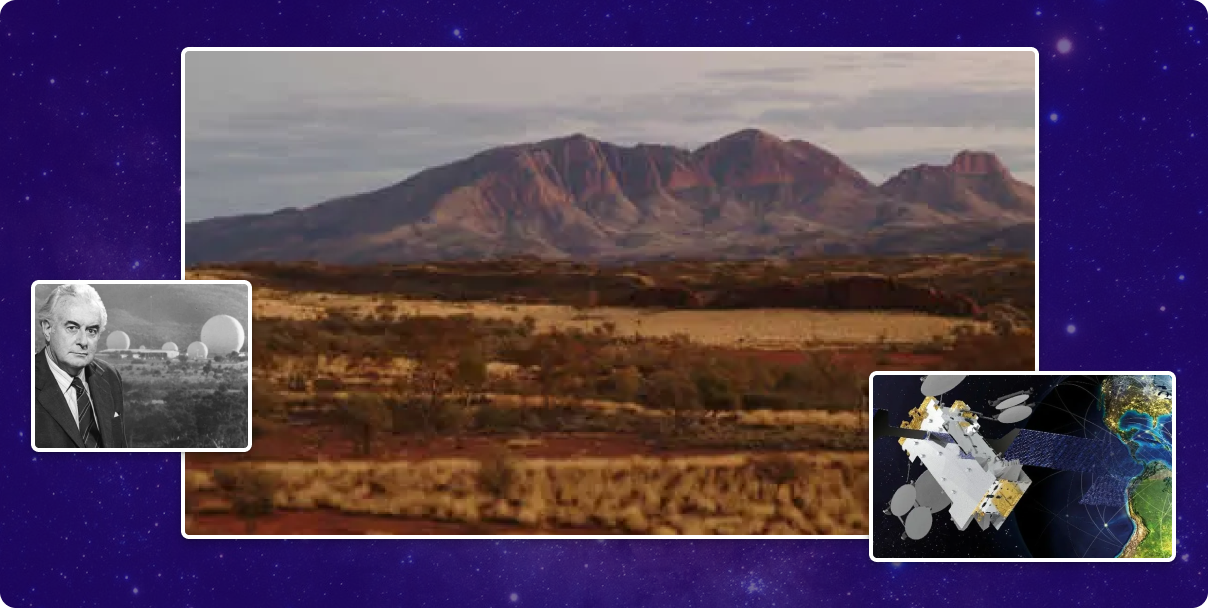
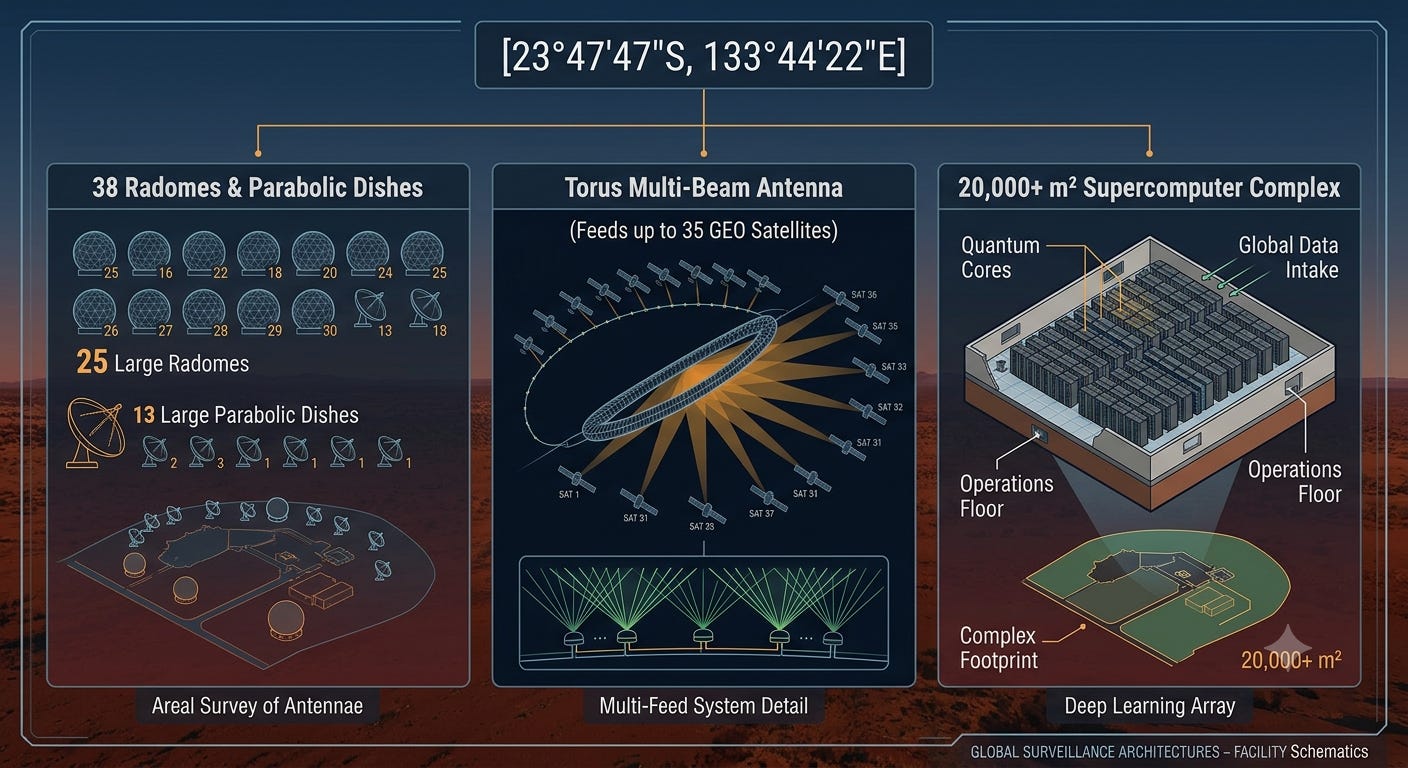
Eighteen kilometers southwest of Alice Springs, the crimson earth of the Australian Outback abruptly surrenders its ancient silence to a cluster of stark, white geodesic domes. This is the MacDonnell Ranges, a landscape defined by scrub, searing heat, and an subterranean water table that once promised isolation. From the air, these structures resemble giant golf balls dropped carelessly into the desert sand. Beneath the fiberglass skins of these thirty-eight radomes, however, sits the electronic central nervous system of Western global hegemony. Officially designated the Joint Defence Facility Pine Gap (JDFPG), this patch of land represents perhaps the most critical technical intelligence asset outside the continental United States.
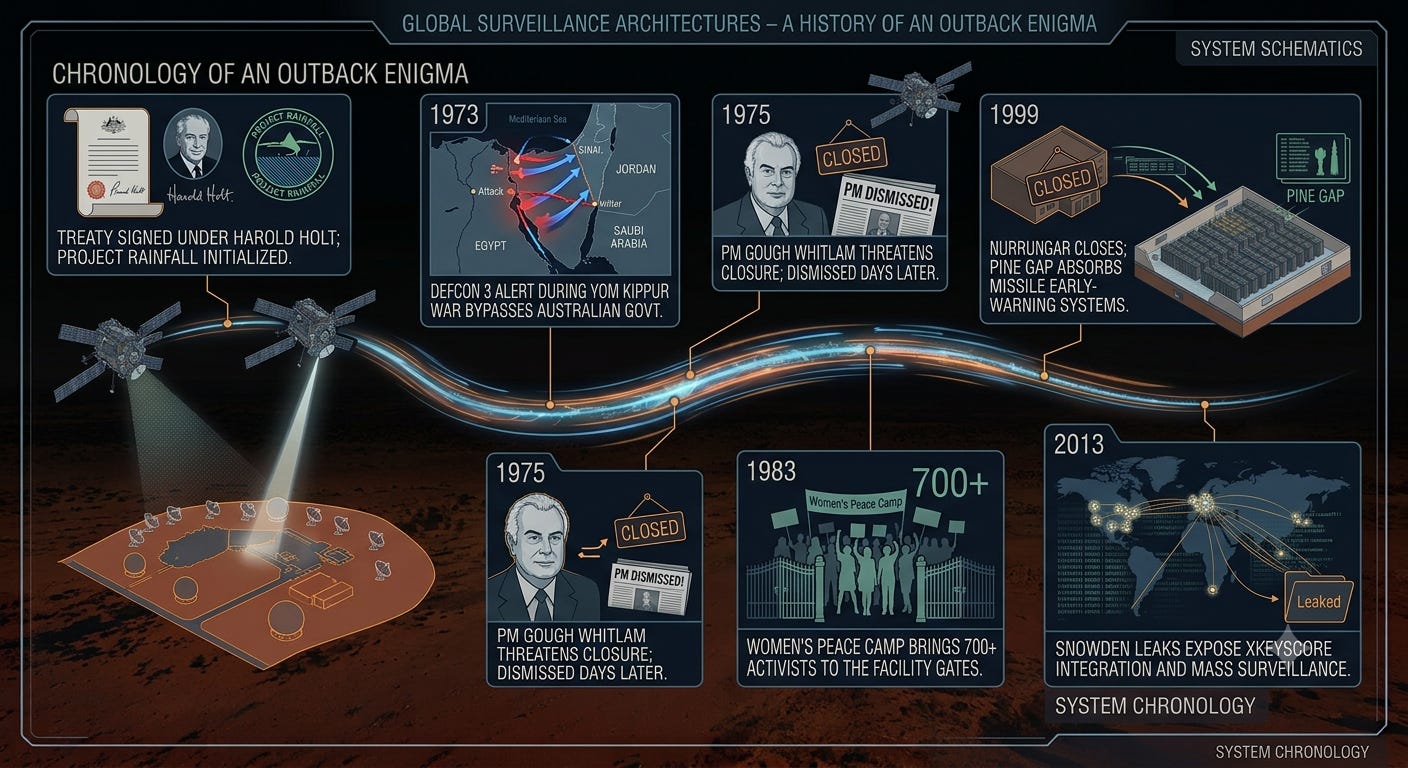
The facility operates far beyond the casual purview of democratic oversight, an existential reality born during the chill of the late 1960s. To comprehend Pine Gap is to understand the geography of absolute invisibility. It was established under the umbrella of a highly classified 1966 treaty signed by Prime Minister Harold Holt and the Lyndon B. Johnson administration. In early bureaucratic memos, the Americans assigned it an evocative, poetic cover name: Project RAINFALL.
The public, meanwhile, received a characteristically sterile title. For decades, official documents labeled the base the “Joint Defence Space Research Facility.” It was an intentional misnomer, a piece of semantic camouflage designed to evoke peaceful astronomical inquiries while masking a massive, unprecedented signals intelligence (SIGINT) network.
When the first four hundred American families arrived in the MacDonnell Ranges in 1970, the town of Alice Springs changed forever. Suburban tract housing materialized amidst the spinifex grass. Swimming pools cleaved through the dust. The newly arrived engineers, cryptologists, and technicians brought an insular, hyper-secure culture to the Northern Territory. They were the ground crew for a revolutionary eye in the sky: a geosynchronous satellite codenamed Rhyolite.
The Geometry of Eavesdropping
Why choose the dead center of the Australian continent? The decision was rooted in pure orbital mechanics and radio-frequency physics. During the 1960s, the Soviet Union was a vast, hermetically sealed landmass stretching across eleven time zones. Ground-based listening posts along its periphery could only glimpse fleeting fragments of Soviet missile telemetry. To capture the full spectrum of electronic data during a ballistic launch, the United States required a satellite that appeared perfectly stationary above the equator, staring down continuously at the Eurasian landmass.
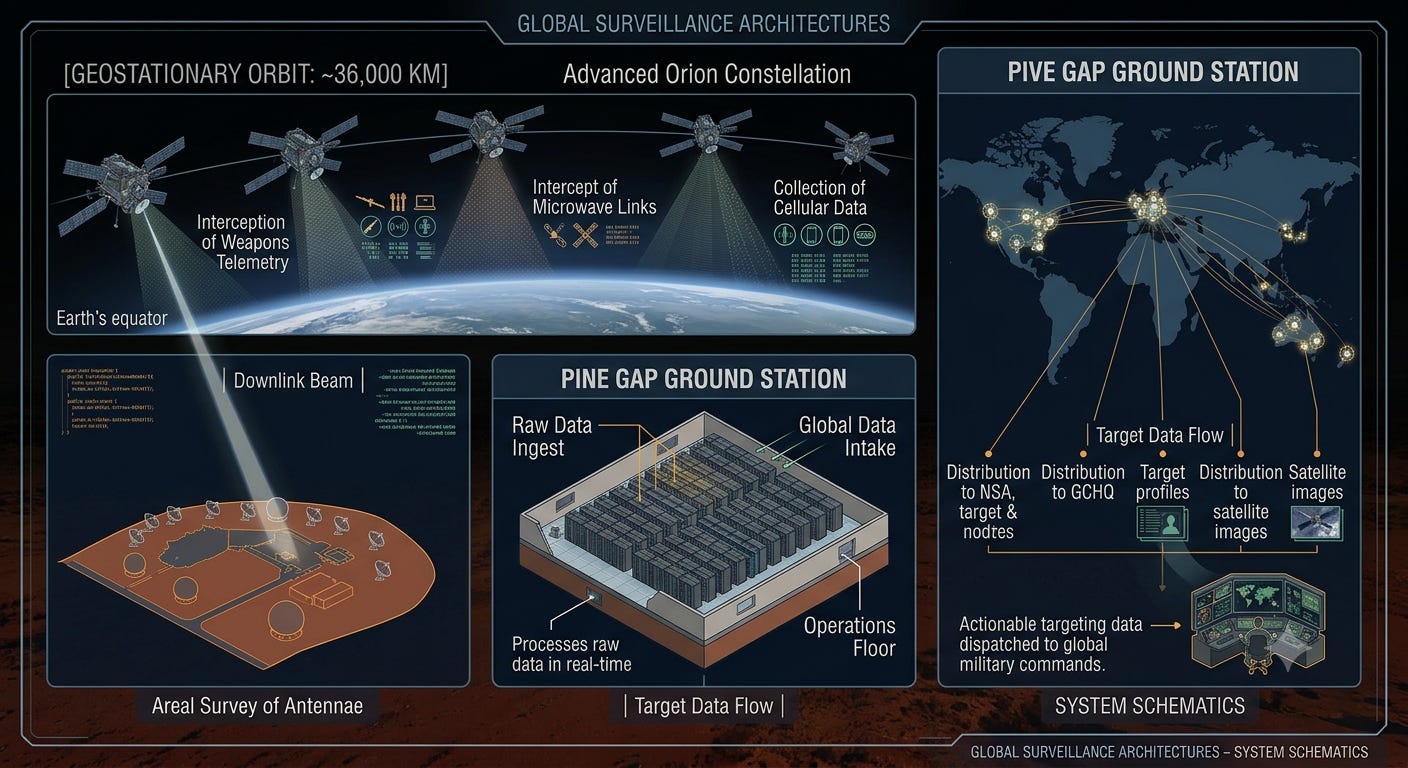
A geostationary satellite parks at an altitude of approximately 36,000 kilometers. At this staggering height, its orbital velocity matches the rotation of the Earth exactly. It never sets. It never moves from its designated quadrant of the sky.
However, a satellite positioned to look deep into the Soviet interior must beam its captured data down to a secure ground station that shares a direct, uninterrupted line of sight. The ground station also had to be safely out of reach of Soviet electronic jamming, naval intercept vessels, and ground-based espionage.
Pine Gap fulfilled every criterion flawlessly. The vast, empty expanse of Central Australia shielded the incoming satellite downlinks from external radio interference. The immense distance from any ocean meant Soviet spy ships idling in international waters could not park offshore to sniff the high-frequency beams traveling between the satellite and the desert floor. The geography offered natural telemetry armor.
The Mechanics of Interception
In its infancy, Pine Gap’s operational mandate focused tightly on weapons verification. When a Soviet or Chinese ballistic missile roared off its launchpad, the projectile transmitted vital internal performance data—known as telemetry—back to its engineers via radio frequencies. The geostationary satellites controlled from the red desert scooped up these delicate, faint signals out of the upper atmosphere. The raw data stream traveled down to the Pine Gap computers, where cryptanalysts mapped the exact payload capabilities, fuel consumption rates, and structural thresholds of America’s adversaries.
As the decades ground on, the technology shifted from analog radio bands to complex digital arrays, and Pine Gap’s appetite for data grew exponentially. The facility evolved from a localized missile-watch station into a core node of the global ECHELON network, an all-seeing electronic net managed by the Five Eyes intelligence alliance.
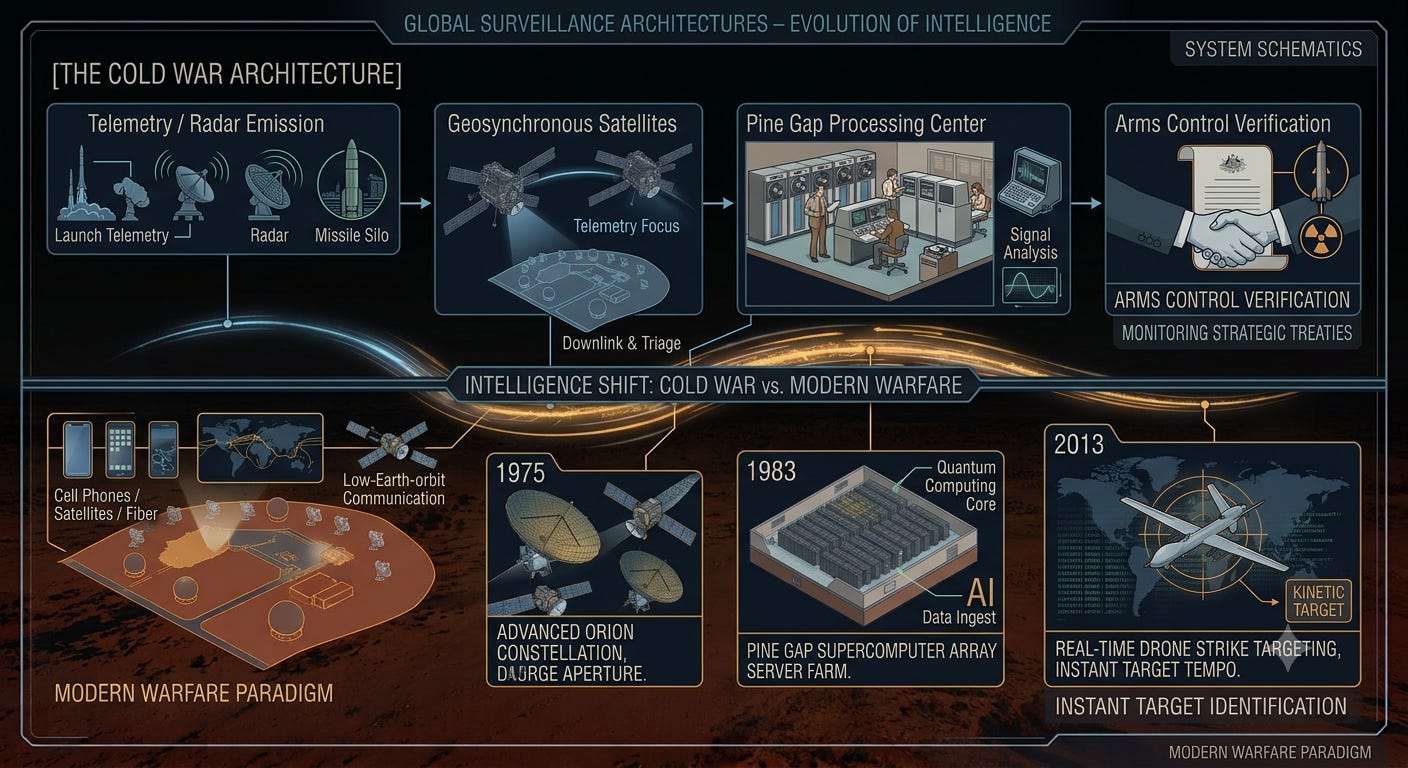
Today, the base coordinates the Advanced Orion constellation, historically referred to as Mission 8300. These massive orbiting platforms deploy dishes roughly the size of a football field in space. They do not just hunt for missile signatures; they harvest everything. They vacuum up anti-aircraft radar pulses, military microwave links, satellite telephone conversations, and maritime tracking data across a footprint that spans from the plains of West Africa across the Middle East to the edge of the Pacific Ocean.
The architectural expansion within the secure perimeter reflects this technical evolution. Since 1970, the secure operations floor has expanded five-fold, growing to more than 20,000 square meters. The complex now outmeasures the playing field of the Melbourne Cricket Ground.
Inside this windowless concrete citadel, the distinction between American and Australian personnel blurs completely. Representatives from the Central Intelligence Agency (CIA), the National Security Agency (NSA), and the National Reconnaissance Office (NRO) sit shoulder-to-shoulder with analysts from Australia’s Defence Intelligence Organisation (DIO) and the Australian Signals Directorate (ASD).
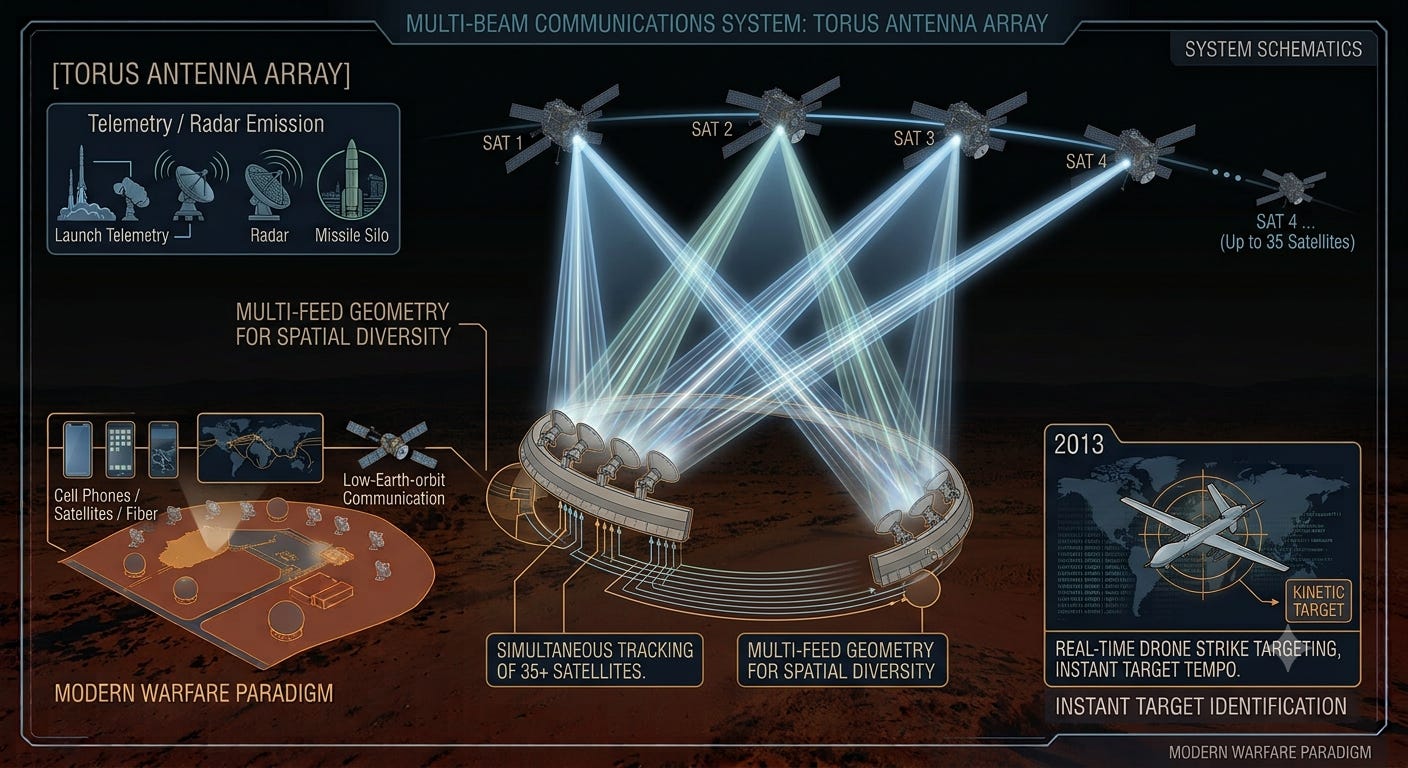
The addition of a massive Torus multi-beam antenna in the 2000s marked a quiet leap in capability. Traditional parabolic dishes must point directly at a single target; they are locked in a one-to-one relationship with a single satellite. A Torus antenna, shaped like a strange, elongated metallic trough, can lock onto and communicate with up to thirty-five geostationary satellites simultaneously. This allows Pine Gap to orchestrate a vast choir of data collection platforms concurrently, processing petabytes of intercepted information in real-time.
Sovereign Friction and Subterranean Geopolitics
The extreme secrecy shrouding Pine Gap has frequently ignited fierce political firestorms within Australia. The fundamental tension is clear: a foreign superpower operates an immense military facility on sovereign Australian soil, fundamentally binding Canberra to Washington’s global war machine.
This friction escalated into an existential constitutional crisis in 1973. During the Yom Kippur War, the Nixon administration placed US military forces on a global nuclear DEFCON 3 alert. Intelligence gathered through Pine Gap regarding Egyptian troop movements on the Sinai Peninsula was funneled directly to the Israeli Defense Forces, proving pivotal to their battlefield counteroffensive.
Astonishingly, the White House issued this nuclear alert without notifying Australian Prime Minister Gough Whitlam. The leader of a sovereign nation discovered entirely by accident that a base on his own territory was participating directly in a nuclear standoff.
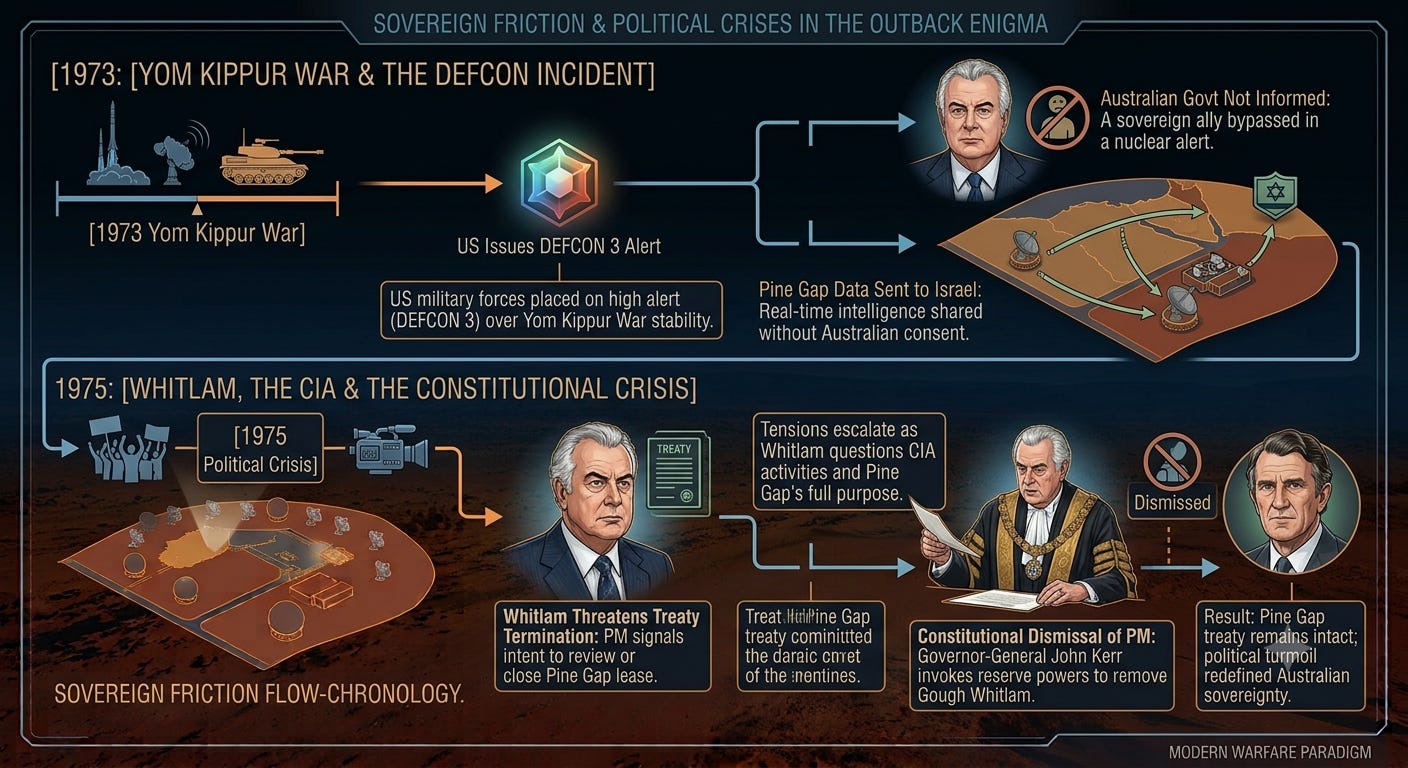
Whitlam, a fiercely independent reformer, was incandescent with rage. By 1975, he publicly threatened to let the Pine Gap lease expire, vowing to uncover the identities of the CIA operatives embedded in the Central Australian desert.
He never got the chance. On November 11, 1975, Governor-General John Kerr invoked archaic reserve powers to dismiss Whitlam from office, a political coup that remains deeply controversial. To this day, declassified files and historical accounts point to intense anxiety within the CIA and MI6 regarding Whitlam’s intent to pull back the curtain on Project RAINFALL.
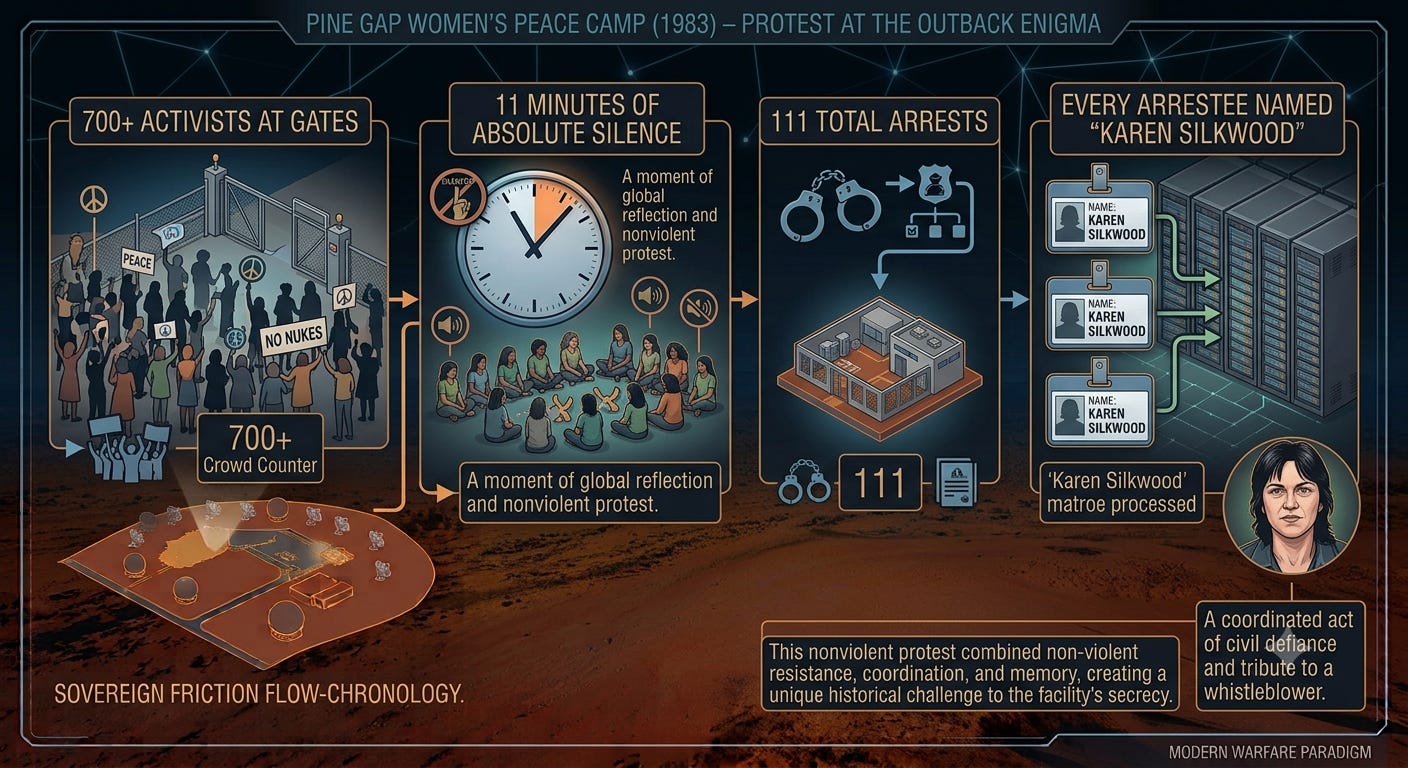
The facility has drawn intense civilian resistance as well. On November 11, 1983, the Pine Gap Women’s Peace Camp began. Led by Aboriginal women, over seven hundred activists marched directly to the security gates.
They sat in absolute silence for eleven minutes, mourning the victims of conflict and commemorating the Greenham Common protests in the United Kingdom. Over a two-week campaign of nonviolent resistance, women scaled the perimeter fences to trespass onto the highly restricted military zone. One hundred and eleven activists were arrested. In a coordinated act of bureaucratic defiance, every single arrested woman gave her name as Karen Silkwood—the American nuclear whistleblower who died under highly mysterious circumstances.
The Kinetic Shift
With the conclusion of the Cold War, the fundamental ethos of Pine Gap shifted dramatically. It was no longer a passive ear observing arms treaty compliance. It transformed into an active tool for real-time combat operations.
When the United States launched its War on Terror following the September 11 attacks, the supercomputers in the Australian desert were retrofitted for a different kind of tracking. Instead of analyzing high-altitude ballistic missile launches, analysts began hunting for the microscopic electronic signatures of individual human beings.
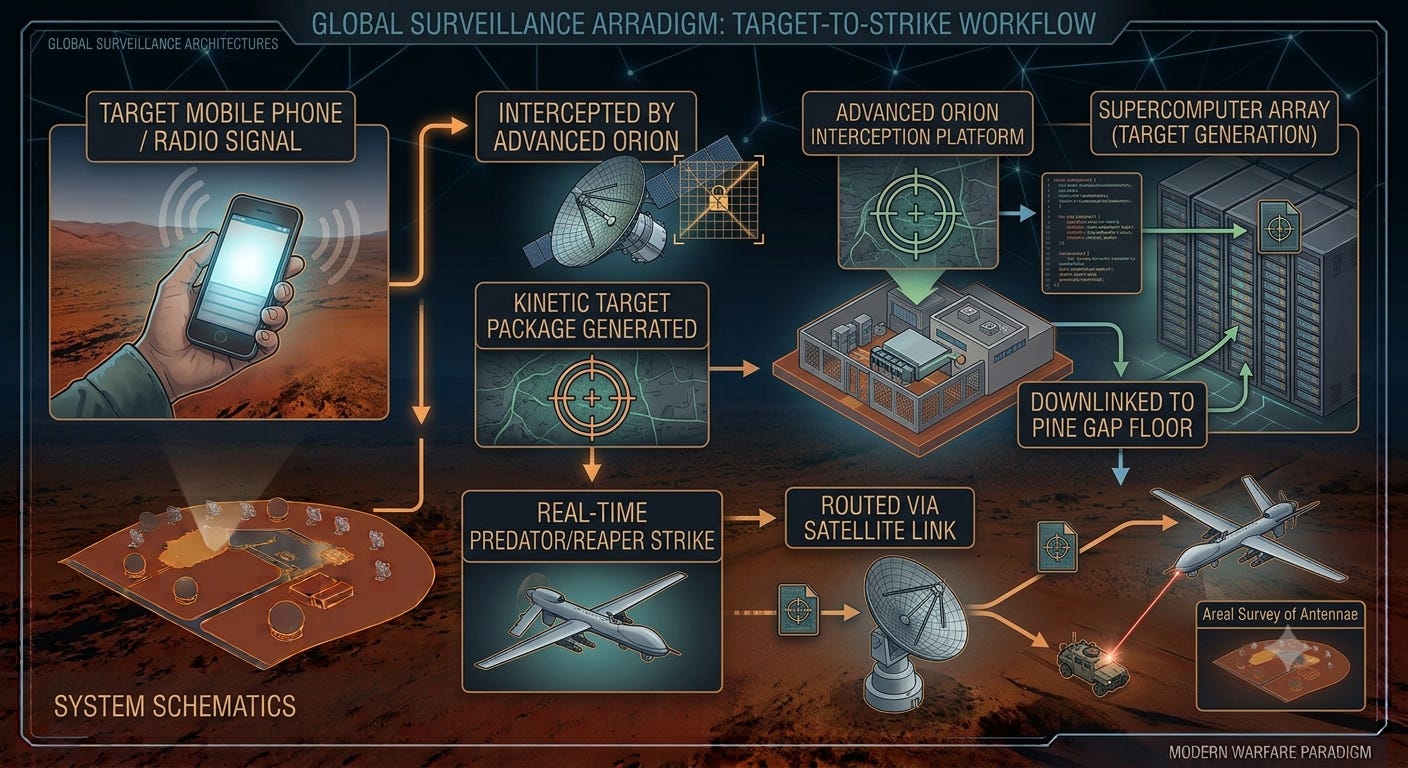
Whistleblower leaks in 2013, orchestrated by Edward Snowden, illuminated this lethal transition. The documents confirmed Pine Gap’s deep integration with the NSA’s XKeyscore program, a massive database that sifts through global internet traffic, chat histories, and cellular geolocation data.
In modern warfare, Pine Gap acts as a target-generation machine. When an insurgent or targeted individual powers on a satellite phone or a cellular device in Yemen, Somalia, or Pakistan, the Advanced Orion satellite intercepts the precise frequency. Within roughly one-fifth of a second, that signal drops into the Pine Gap operations floor.
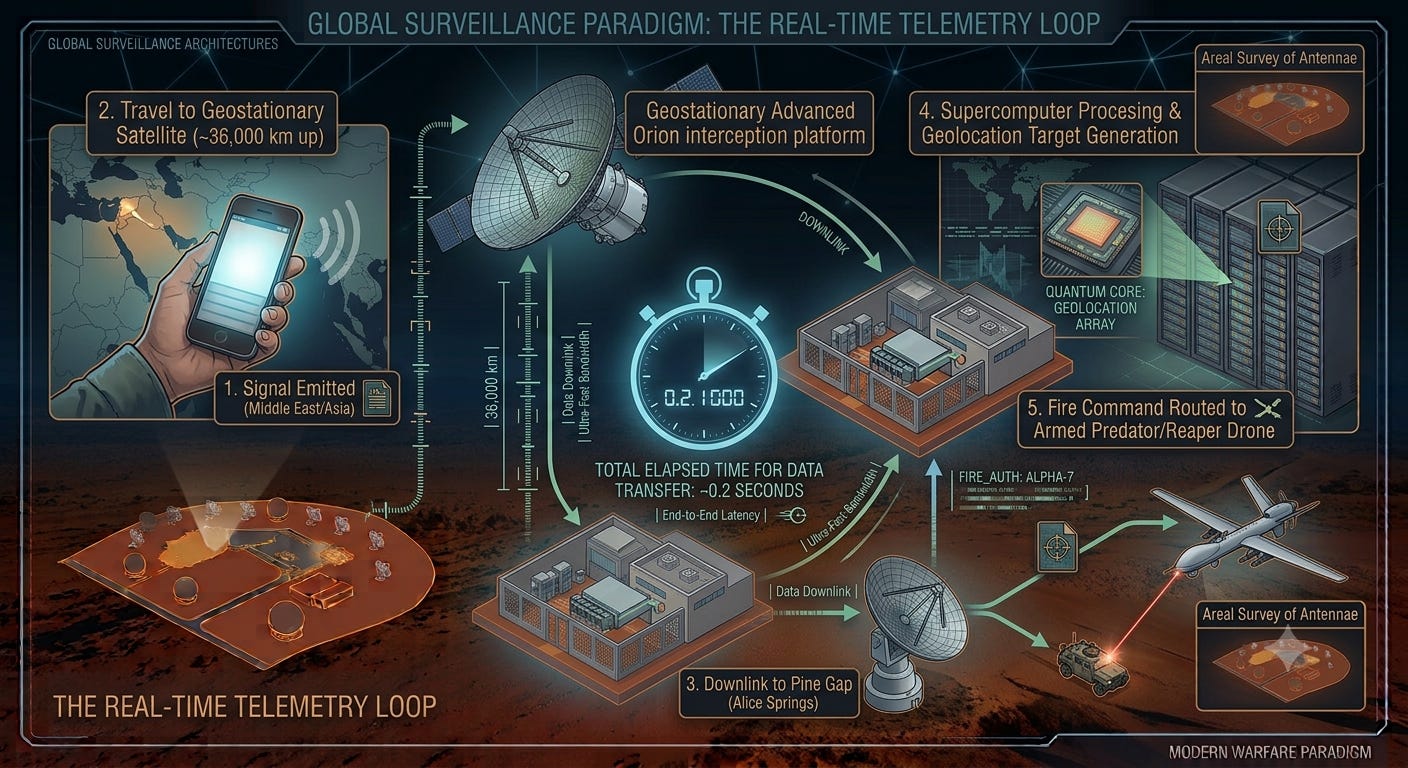
The supercomputers calculate the exact geographical coordinates of the transmission. This metadata forms a highly precise target package. The location data is beamed via military networks to armed Predator or Reaper drones loitering in the airspace thousands of miles away.
The missile strike that follows is directly enabled by the technical infrastructure buried in the Australian wilderness. This reality means Australia remains an active, inescapable participant in America’s modern remote warfare operations, a geopolitical codependency that continues to generate quiet unease across the Pacific.
Deep-Desert Espionage: The Visual Record
To better understand the scale and historical significance of the facility, exploring archival imagery and structural overviews provides critical context on how this base grew from a small Cold War outpost into a massive intelligence hub.
This concise overview examines the historical evolution of the facility and explains how its deep-desert geolocation capabilities directly connect to modern global military operations.

Help us grow by advertising your business in our newsletter and reaching an engaged community.
