
⚡ThirdSpace BUZZ: "I'm Not A Mobster, I'm A Strategic Consultant"
The Ledger of Lost Causes. Why your "side hustle" is just organized crime with better tax software.
ThirdSpace BUZZ is an edgy newsletter on whatever the fuck I want.
Welcome back, everyone. I see you’ve all been busy. You’re all looking for the perfect, untraceable way to move money while simultaneously wanting to be the main character in a high-stakes, international thriller.
Spoiler alert: If you’re using a crypto-exchange based in a country that doesn’t have an extradition treaty, you’re not a “financial architect”—you’re just a guy waiting for a very long, very uncomfortable conversation with the feds.
But hey, keep “grinding.”
Grab your espresso; let’s talk about how to lose everything with style.
⚡

Sponsored by:
Help us grow by sponsoring our newsletter and reaching an engaged community.

“The secret of business is to know something that nobody else knows.”
— Aristotle Onassis

⚡ The Architecture of a Boutique Syndicate
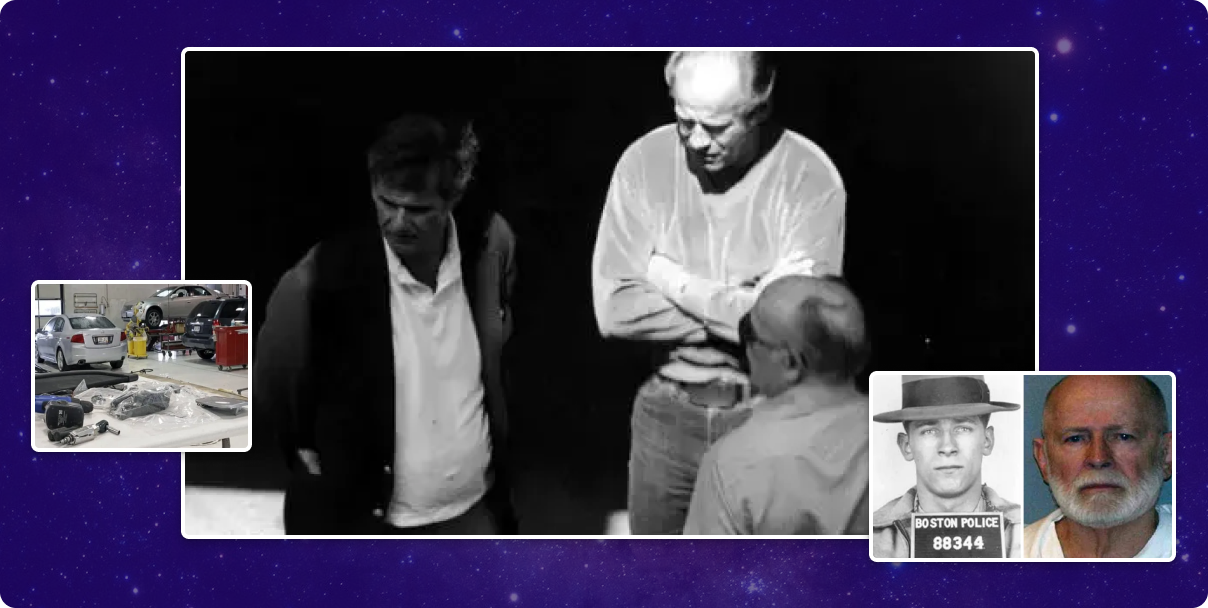
When we talk about the Winter Hill Gang, we are talking about a paradox. They were a local, Irish-American crew from Somerville and South Boston who somehow managed to link arms with international revolutionaries in Northern Ireland, influence professional sports in the Midwest, and dismantle the established Italian Mafia hierarchy in Boston—all while operating as an “extortion-based” regulatory body.
To understand their success, you have to stop thinking of them as a “gang” in the street-brawl sense. Think of them as a decentralized, connection-based enterprise. They weren’t interested in being the only ones on the street; they were interested in being the ones taxing everyone else on the street.
The “Tax” as a Business Model
Under James “Whitey” Bulger, the gang transitioned from being direct operators to becoming the “regulatory” body of the Boston underworld. If you wanted to run a bookmaking shop, sell illicit goods, or manage a loan-sharking outfit in their territory, you paid the “tax.”
This wasn’t just bullying; it was a sophisticated ecosystem. By acting as the taxman, Bulger created a protective buffer. He famously kept heroin out of South Boston not because he was a saint, but because it brought unwanted police heat. By policing their own backyard, they maintained a sense of order that allowed their rackets—which included high-stakes loan sharking and sports betting—to flourish.
From Race-Fixing to World Jai Alai
Before the “tax” model, the gang—under Howie Winter in the 1970s—cut their teeth on systemic race-fixing. This was their first real foray into multi-state operations. They didn’t just fix a single race; they fixed the infrastructure of betting across Massachusetts, New Hampshire, and Rhode Island.
This taught them the value of skimming. Later, when they infiltrated World Jai Alai in Florida and Connecticut, they applied the same principle on a corporate scale. They didn’t need to own the company; they just needed to skim enough off the top so that the business remained profitable enough for the owners to stay quiet, but illicit enough for the gang to make millions. It’s a blueprint that every crypto-launderer should study: the best way to steal is to make sure your victim remains solvent.
The “Diversified Portfolio” Strategy
The Winter Hill Gang was never “brittle.” They survived because they played in multiple sandboxes:
The Logistical Pipeline (The IRA): They facilitated arms smuggling to the Provisional IRA in Northern Ireland. This wasn’t just for cash; it gave them a transnational reputation and solidified their standing within the Irish-American diaspora.
The Muscle (Outlaw Motorcycle Gangs): When they needed to move goods or personnel across state lines quickly, they didn’t use their own men. They utilized the nomadic, multi-state reach of various biker clubs. It was a perfect symbiosis: the bikers got “political” cover through the gang’s FBI connections, and the gang got a flexible, mobile distribution network.
The Professional Interference (The Detroit/Mafia Ties): They held meetings at neutral grounds like the Lancaster Street Garage, coordinating with the Detroit Partnership (the Zerilli family). These weren’t mergers; they were professional handshakes between equals in different geographic markets.
The Fallacy of the “Protected” Status
The gang’s most critical, and ultimately self-destructive, asset was their relationship with corrupt FBI handlers, most notably John Connolly. This connection allowed them to dismantle rivals—most famously the Angiulo brothers of the Patriarca family—by feeding the FBI the intelligence needed to wipe them out.
However, the Roger Wheeler case proves the limit of this power. When Wheeler, the owner of World Jai Alai, refused to be intimidated and began an internal investigation, he became the “wild card.” The gang assumed he would play by the rules of the underworld. He didn’t. His murder in Tulsa, Oklahoma, was the beginning of the end. It turned a local administrative problem into a federal investigation that even a bought-and-paid-for FBI agent couldn’t bury.
The “Ghost” Phase: A Lesson for the Fugitive
Bulger’s 16 years on the run—culminating in his arrest in a quiet Santa Monica apartment—is the final, chilling chapter of this story. He went from being the man who “taxed” an entire city to an old man living in rent-controlled anonymity.
They didn’t build an empire that lasted. They built a network that was brilliant, predatory, and ultimately, a hollow shell. They were never empire-builders; they were just the ultimate connection-seekers. And in the end, the ghosts always catch up to the ones who spend their lives trying to outrun the system.
🏘️ Inside Marshall Auto Body
The Winter Hill Gang’s primary hangout was Marshall Auto Body, a nondescript garage at 12-14 Marshall Street in Somerville, Massachusetts, that served as a heavily fortified nerve center for their criminal enterprise. From the outside, it looked like a standard vehicle repair shop, but the interior was rigged for maximum security and secrecy, featuring reinforced doors, specialized surveillance scanners, and a hidden trapdoor in the main office floor that led straight to the basement.

Help us grow by advertising your business in our newsletter and reaching an engaged community.
