
⚡ThirdSpace BUZZ: How Your Local Gas Station Became a Hub for Organized Crime
Forget the price at the pump; the real cost is being funneled into a massive, multi-billion-dollar tax evasion syndicate hiding right under your nose.
ThirdSpace BUZZ is an edgy newsletter on whatever the fuck I want.
Look at you, waiting forty minutes in line to pay an exorbitant fee for a beverage-priced liquid that makes your car go. It’s truly heartwarming how we all suffer together, isn’t it?
While you ponder the geopolitical implications of global oil, you’re missing the actual heist happening right in your own backyard.
⛽

Sponsored by:
Help us grow by sponsoring our newsletter and reaching an engaged community.


“The law is a spider’s web, which catches the small flies, but lets the wasps and hornets break through.”
— Jonathan Swift

⚡ The Great Gas Heist: A History of “Paper” Crime
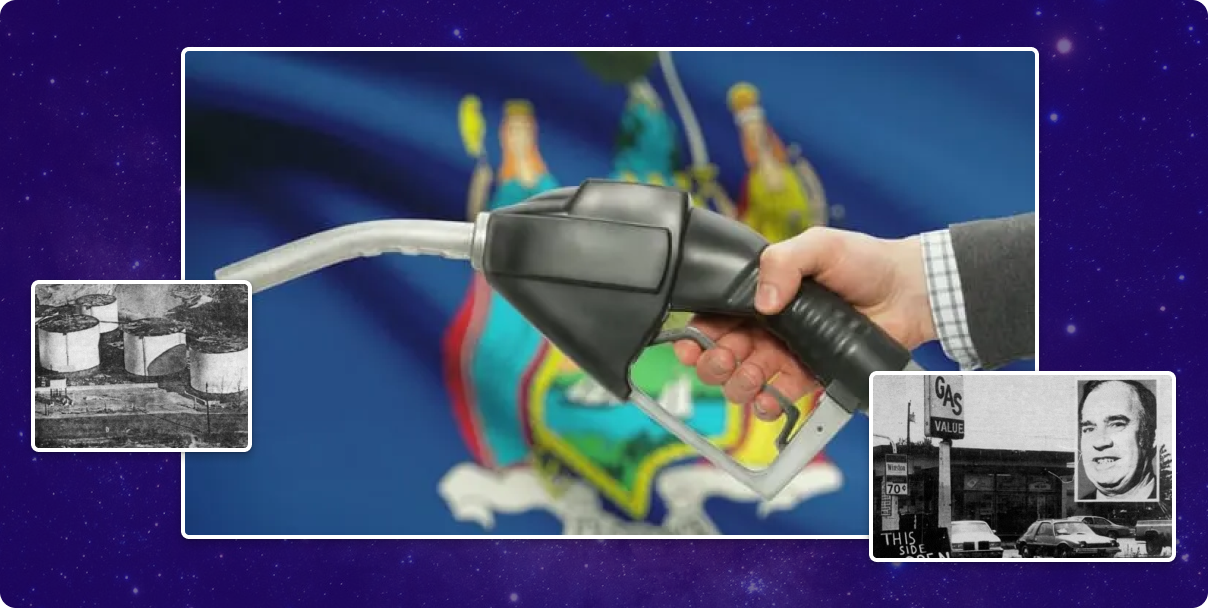
The 1970s and 80s were supposed to be about conservation, national energy security, and the tragic struggle of the American commuter. Instead, they became the greatest “white-collar” gold rush in history. While you were counting your pennies to fill up your sedan, a shadow industry was being built in the offices of forgotten shell companies—an industry that didn’t care about the price of crude, but rather the massive excise taxes attached to every gallon.
The Architecture of the “Daisy Chain”
To understand why the “gas shortage” was such a gift to organized crime, you have to look at the tax structure. In the United States, gasoline is taxed at the wholesale level. The government expects the distributor to collect these taxes and pass them on. It is a system built on trust and antiquated accounting.
In the late 1970s, as the price of fuel skyrocketed, so did the tax burden. A group of individuals, primarily associated with the Colombo and Genovese crime families, realized that if they could insert themselves into the supply chain, they could essentially manufacture money. They created “daisy chains”—long, complex sequences of shell companies that passed fuel back and forth.
The goal was never to sell gas efficiently. The goal was to pass the product through as many entities as possible until the trail of the tax liability vanished. The final company in the chain—the “burn company”—would collect the taxes from the retailer, keep the money, and then file for bankruptcy before the IRS or state authorities could catch up. By the time the government realized the company was a fraud, the principals had siphoned the funds, often laundering them through offshore accounts or into legitimate real estate ventures.
The Marriage of Muscle and Math
The most fascinating element of this era was the evolution of the criminal profile. Traditional Mafia figures were experts in extortion, gambling, and labor racketeering. They understood the streets. But “daisy chains” required a different set of skills: forensic accounting, legal maneuvering, and an understanding of international shipping logistics.
This is where the alliance with emerging Russian and Soviet-bloc organized crime became essential. Figures like Marat Balagula didn’t come up through the traditional Italian-American ranks. They were survivors of a different system, possessing a level of sophistication in finance that allowed them to navigate the complexities of the wholesale fuel market.
They brought the “paperwork” that made the fraud possible, while the traditional mob families brought the “enforcement.” If a gas station owner was hesitant to participate in the scheme—or if a competitor tried to undercut their artificial pricing—the Mafia ensured that the “proper” business decisions were made. It was a perfect, albeit toxic, synergy of brute force and bureaucratic manipulation.
The Invisible Impact
For the average citizen in the 1980s, these schemes were largely invisible. They didn’t see the shell companies in Delaware or the falsified tax filings in New York. They just saw gas stations that always seemed to have supply, even when the rest of the world was in a crisis.
These bootlegging operations could sell fuel to retailers at prices slightly lower than legitimate distributors, simply because they weren’t paying the 30-cent-per-gallon tax. This made them highly competitive. They were effectively subsidizing their own growth with stolen government revenue. At the height of the crisis, it was estimated that in the New York area alone, nearly 10 percent of all gasoline sold had bypassed the tax system.
The “Burn Company” Legacy
The impact of this era on American law enforcement was profound. It signaled the end of the “Al Capone era” of mobsters being brought down for simple tax evasion on their personal income. Instead, the government had to develop its own army of forensic accountants, tax attorneys, and complex-crime specialists to dismantle these networks.
The “burn company” strategy, however, didn’t disappear with the crackdown on gasoline racketeering. It became a blueprint. We see the same tactics today in labor leasing fraud, where shell companies provide “cheap” construction labor by failing to pay payroll taxes, and in modern financial fraud, where high-frequency trading and crypto-laundering provide new playgrounds for the same types of sophisticated, risk-averse criminals.
A Final Reflection for the Road
The next time you pull up to the pump, don’t just think about the cost per gallon. Think about the system. The gas shortage of the 70s proved that whenever you create a high-value, highly taxed, and highly regulated commodity, you create a vacuum. And in that vacuum, you will always find someone—be it a savvy street boss, a corrupt accountant, or an opportunistic international syndicate—ready to turn your daily routine into their personal profit center.
The history of gasoline in the United States isn’t just a story of engineering or diplomacy; it is a story of how the most mundane parts of our lives are often the ones most vulnerable to the most calculated, complex, and invisible crimes. The “Cannolo” of the world aren’t just in the shadows; they’re sitting in the office across from yours, filing a tax form that will never actually be paid.
🏘️ An $85 Million Tax Heist
The M & Q Terminal at 251 Lombardy Street in Greenpoint served as the clandestine engine room for massive gasoline tax evasion. By executing fraudulent “book transfers” within the facility, the New York Fuel Terminal Corporation orchestrated a complex daisy chain of shell companies. While millions of gallons remained physically stored in Brooklyn tanks, their paper ownership vanished through legal loopholes, successfully defrauding the government of $85 million in excise taxes.

Help us grow by advertising your business in our newsletter and reaching an engaged community.
