
ThirdSpace BUZZ is an edgy newsletter on whatever the fuck I want.
We live in a world that assumes its institutions are built by accountants, logisticians, and hard-nosed pragmatists.
Yet, if you pull back the administrative curtain on the architecture of modern statecraft, you find something entirely different.
You find a smoke-filled room populated not by career bureaucrats, but by stage magicians, Hollywood special effects supervisors, pulp fiction novelists, advertising executives, and sleight-of-hand artists.
The historical crossover between the arts of illusion and the science of espionage is not merely a curious footnote or a clever piece of trivia. It is the foundational DNA of modern intelligence.
🍓

Sponsored by:
Help us grow by sponsoring our newsletter and reaching an engaged community.

“The hand is quicker than the eye.”
— Traditional Magic Proverb

🍓 The Fiction Makers
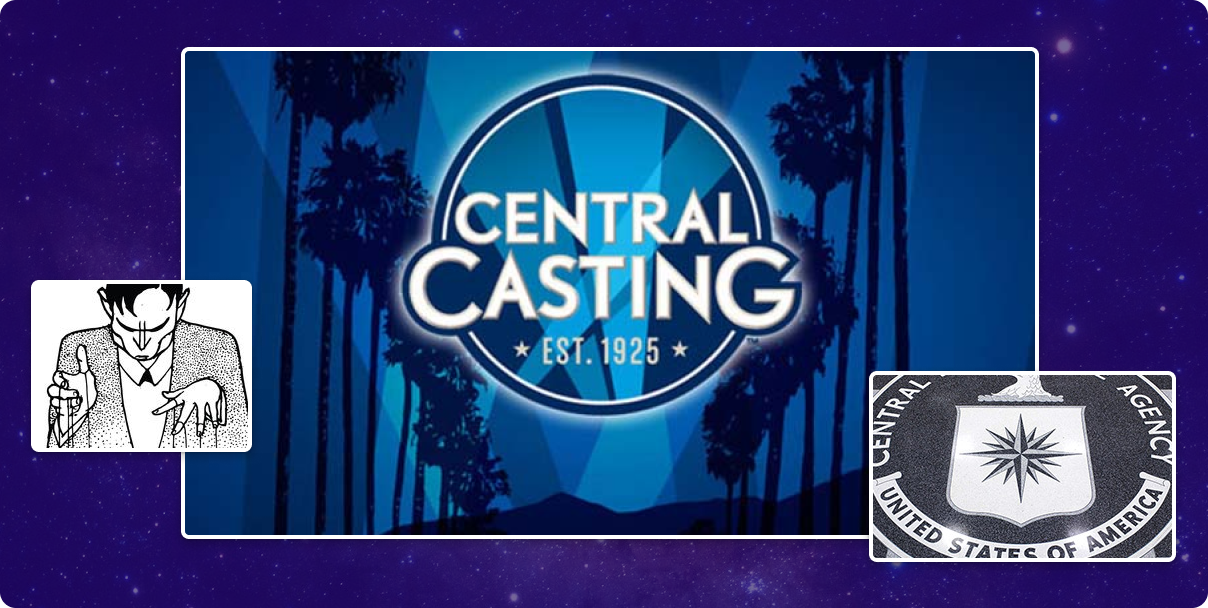
When the United States formalized its first centralized espionage apparatus during the Second World War, its leaders realized a profound truth: to manipulate a foreign power, you cannot merely out-shoot or out-compute them. You have to out-narrative them. You have to construct a convincing, immersive fiction that the enemy’s own paranoia, psychology, and institutional biases will cause them to accept as hard reality.
Examine how the wartime innovators of the Office of Strategic Services (OSS) and its psychological warfare divisions built the blueprint for modern subversion, how the technical departments of the Central Intelligence Agency evolved into real-world “Q Branches,” and why the boundary between a novelist crafting a conspiracy and an intelligence officer executing one has always been dangerously, fascinatingly thin.
The Genesis of the Subversive Theater
Before the Second World War, American intelligence was an amateur enterprise. It was decentralized, chronically underfunded, and heavily reliant on military attachés who gathered intelligence through polite diplomatic channels or casual observation. The concept of an institutionalized, proactive agency dedicated to clandestine operations, sabotage, and psychological subversion simply did not exist in the American government lexicon.
That all changed under the pressure of total global war. In 1942, President Franklin D. Roosevelt appointed William “Wild Bill” Donovan—a decorated World War I hero and visionary lawyer—to organize and lead the Office of Strategic Services (OSS). Donovan understood early on that conventional military might alone could not defeat the Axis powers. The war was being fought not just on physical battlefields in Europe and the Pacific, but in the minds of populations, within the corridors of enemy command structures, and across the fragile psychological fault lines of fascist regimes.
Donovan looked at the traditional military recruitment pipelines and rejected them entirely. He did not want predictable West Point lifers or rigid bureaucrats for his most sensitive operations. Instead, he sought out what he termed “magnificent non-conformists.” He scoured Ivy League faculty lounges, Broadway casting offices, advertising agencies on Madison Avenue, publishing houses in New York, and Hollywood studios.
The resulting workforce was the most eccentric collection of talent ever assembled under a single government payroll. Anthropologists rubbed shoulders with stage magicians; structural engineers drank with historical novelists; poets and set designers collaborated on sabotage manuals. This eclectic mix was gathered under the recognition that creating a successful covert operation requires the exact same skill set as staging a Broadway play or writing a compelling thriller:
The Premise: Establishing an objective that defies conventional logic.
The Suspension of Disbelief: Designing props, documents, and covers so airtight that targets do not question their authenticity.
The Choreography: Managing human behavior, timing, and environmental factors to ensure the audience—in this case, the enemy—reacts exactly as scripted.
Out of this philosophy emerged specialized subdivisions that would forever alter the nature of statecraft, most notably the Morale Operations Branch.
The Morale Operations Branch and the Art of “Black” Subversion
Tucked inside the architecture of the wartime OSS was the Morale Operations (MO) Branch, formally established in March 1943. While other branches focused on gathering intelligence or arming physical resistance groups in occupied territories, the MO Branch was assigned a much more insidious and psychological mandate: waging “black propaganda” and subversion.
To understand the operational philosophy of the MO Branch, one must understand the lexicon of wartime information warfare. In intelligence nomenclature, the color of propaganda refers entirely to its attribution:
White Propaganda: Open, transparent, and originating from a known, acknowledged source. It is official state broadcasting, public pamphlets, and recognized declarations.
Grey Propaganda: Ambiguous in origin. The source is unstated or obscured, floating into the public sphere without a clear signature, leaving audiences to wonder where it came from.
Black Propaganda: Deliberately, meticulously falsified. It is information designed to look as though it originated from an entirely different source—specifically, from within the enemy’s own ranks, domestic resistance networks, or fractured command structures.
The MO Branch specialized entirely in “black” operations. Their explicit goal was to induce paranoia, panic, political fracturing, and fatal paralysis within Nazi Germany and Imperial Japan. They did not want citizens in Berlin or Tokyo to simply doubt the war effort; they wanted them to suspect that their own generals, SS officers, and government ministers were betraying them.
The staff of the MO Branch approached this task with the technical precision of master craftsmen. Because they were staffed by advertising executives, copywriters, and artists, they understood that propaganda fails if it sounds like it was written by an enemy. To be effective, a piece of black propaganda had to mirror the exact bureaucratic tone, paper stock, ink viscosity, typographical quirks, and psychological anxieties of the target regime.
Consider one of the most famous MO initiatives: Operation Cornflakes. The operation recognized that the German postal service was a critical lifeline of the Nazi state, and that ordinary German citizens and soldiers trusted mail implicitly. OSS operatives acquired captured mailbags, forged thousands of anti-Nazi letters, slipped them into authentic German envelopes bearing legitimate postmarks, and stuffed them with forged newspapers and pamphlets designed to look like the output of a secret internal German resistance movement called Das Neue Deutschland (The New Germany).
These forged mailbags were then loaded onto Allied bombers and dropped over enemy rail lines where mail cars had been recently wrecked by sabotage or bombing raids. When railway workers or postal inspectors recovered the scattered mail, they assumed the pouches were simply recovered from damaged official transport and dutifully fed them back into the standard postal sorting system. Thousands of German homes and military barracks thus received subversive, demoralizing literature directly through their own trusted postal network, bearing all the hallmarks of domestic dissent.
The psychological devastation was profound. By making the enemy believe the rot was coming from within, the MO Branch bypassed the natural defensive skepticism that citizens apply to foreign broadcasts. They turned the enemy’s own infrastructure into a weapon against them.
The Directorate of Science and Technology and the Birth of the Modern “Q Branch”
When the Second World War ended, the OSS was abruptly dissolved. President Harry S. Truman, suspicious of centralized intelligence agencies during peacetime, dismantled the organization. However, the geopolitical realities of the emerging Cold War made a permanent intelligence apparatus an absolute necessity. By 1947, the National Security Act established the Central Intelligence Agency (CIA).
The operational DNA of the OSS survived the transition, but the demands of the atomic age required a professionalization of technical craftsmanship. Espionage was no longer just about invisible ink, forged ration books, and drop dead-letter boxes; it required advanced signals intelligence, high-altitude reconnaissance, chemical interrogation countermeasures, and hyper-realistic physical disguises.
To institutionalize these capabilities, the CIA established the Directorate of Science and Technology (DS&T) in August 1963. The DS&T was designed to bring the rigor of hard sciences, engineering, and industrial design directly into the service of clandestine operations. It oversaw monumental technological leaps, from the development of the U-2 spy plane and early reconnaissance satellites to the most intimate tools carried by human operatives in the field.
Within the DS&T sits its most cinematic and legendary subdivision: the Office of Technical Service (OTS).
If the DS&T provided the orbital eyes and high-altitude wings of the modern intelligence community, the OTS provided its teeth, its keys, and its faces. Often compared—accurately—to the fictional “Q Branch” from Ian Fleming’s James Bond series, the OTS is the physical manifestation of the intelligence community’s “central casting.”
When an operative needs to slip past border security in a hostile authoritarian state without drawing a second glance, they do not rely solely on a fake passport. They rely on the OTS. The office houses specialized disguise laboratories, master mask-makers, prop fabricators, locksmiths, and chemical engineers whose job is to engineer absolute, living illusions.
The historical crossover between Hollywood and the OTS is deep and well-documented. During the height of the Cold War, the CIA regularly contracted legendary Hollywood special effects artists, makeup pioneers, and even professional magicians to train its operatives and build its equipment.
The Magician Consultant: In the 1950s and 60s, the CIA famously retained the services of John Mulholland, a legendary American stage magician and editor of the magic journal The Sphinx. Mulholland was commissioned to write secret manuals on deception, sleight-of-hand, concealment, and psychological misdirection for agency operatives. His manuals detailed how to surreptitiously slip chemical substances into a target’s drink in a crowded room, how to pass notes without detection, and how to use natural human cognitive blind spots to evade surveillance.
The Master of Disguise: Figures like Tony Mendez, who served as the CIA’s Chief of Disguise, blurred the line between cinematic art direction and geopolitical rescue operations. Mendez and his team utilized Hollywood prosthetics, custom-molded silicone masks, posture alterations, and voice-training techniques to transform operatives into entirely different human beings. Their work reached public consciousness through the famous Argo operation, where American diplomats trapped in revolutionary Iran were successfully exfiltrated by being disguised not as secret agents, but as a Hollywood film crew scouting locations for a fake science-fiction movie.
The OTS proved that the boundary between a Hollywood backlot and a CIA laboratory is effectively porous. Both industries exist to construct an alternate reality that the audience is forced to believe is real.
The Mechanics of Illusion — How Fiction Infiltrates Fact
Why is the intersection of fiction-writing, stagecraft, and espionage so persistently effective? To answer that, we must look at how human cognition operates under stress, and how institutions process incoming threats.
Human beings—and by extension, complex bureaucratic organizations like intelligence agencies, military juntas, and totalitarian governments—do not process the world through pure, objective data. They process the world through narrative frameworks. When an intelligence service receives a report, a intercepted letter, or a sighting of a suspicious individual, they evaluate that data against an existing mental model of what they expect to happen.
This cognitive vulnerability is precisely what the practitioners of theatrical espionage exploit.
Exploiting Institutional Bias: A totalitarian regime is inherently paranoid. It expects betrayal, internal dissent, and factional infighting because its entire power structure is built on coercion rather than consent. When the OSS’s Morale Operations Branch drafted poison-pen letters implicating specific Gestapo commanders in anti-Hitler conspiracies, they were not inventing a new fear out of whole cloth; they were feeding an existing, latent paranoia. The German security apparatus wanted to believe that rivals were plotting against them, which made the forged evidence psychologically irresistible.
The Power of Visual Authority: In the physical world, authority is communicated through props, costumes, and environmental design. A man in a tailored uniform carrying a leather briefcase with the correct institutional crest stamped on the leather does not get asked for his ID; he is granted passage because his visual cues trigger an automatic, unthinking compliance in the human observer. The OTS understands that the best disguise is not one that looks fake or theatrical, but one that is so utterly mundane, so perfectly integrated into the expectations of the local environment, that it becomes invisible.
The Scripting of Events: In a covert operation, spontaneity is the enemy of success. The most successful operations are heavily scripted, rehearsed, and staged like theatrical productions. Every prop—from a forged transit pass with the correct microscopic fiber content to a matchbook from a local cafe that burned down three years prior—must support the illusion. If a single prop feels out of place, the suspension of disbelief shatters, and the entire production collapses into catastrophe.
The Contemporary Legacy and the Modern Mind-F*ck
As we look at the contemporary landscape of global intelligence, the lessons forged by the novelists of the OSS and the makeup artists of the OTS have only grown more urgent.
We live in an era where the traditional boundaries of “black propaganda” have expanded from forged postal bags and radio broadcasts into the digital ether. The modern equivalent of the MO Branch no longer drops leaflets from bombers or slips letters into mail trains; they deploy computational propaganda, synthetic media, deepfakes, and coordinated disinformation campaigns designed to exploit the ideological polarization of democratic and authoritarian societies alike.
Yet, the fundamental mechanism remains identical to the one Bill Donovan and his “magnificent non-conformists” pioneered in 1943. Whether you are a Hollywood makeup artist sculpting a silicone face in Langley, a World War II copywriter drafting a fake resistance newsletter in London, or a modern disinformation architect manipulating social media feeds, the core tradecraft is the same: you are writing a script, casting the players, and convincing the target audience to perform your desired action on a stage they do not realize they are standing on.
When you trace this lineage—from the theatrical subversions of the Second World War, through the cold war laboratories of the Directorate of Science and Technology, to the quiet offices where real-world props are crafted to mimic fiction—it fundamentally alters how you view history.
It reveals that the world is not merely governed by cold, mechanical forces. It is shaped, maneuvered, and occasionally upended by storytellers. The line separating a novelist inventing a spy thriller from an intelligence officer executing a clandestine operation is not a wall at all; it is merely a revolving door. And once you see how the illusion is built, you can never look at the machinery of power the same way again.

Help us grow by advertising your business in our newsletter and reaching an engaged community.
