
ThirdSpace BUZZ is an edgy newsletter on whatever the fuck I want.
As global trade shifts away from single currency dominance, emerging economies are actively constructing sovereign payment architectures to safeguard their financial stability.
Platforms like mBridge and interconnected central bank digital currencies allow sovereign states to execute cross border settlements with unprecedented speed and efficiency.
Consequently, this quiet monetary evolution is fundamentally reshaping international commerce, offering resilient, seamless trade routes that operate independent of traditional Western financial messaging network channels.
🍋🟩

Sponsored by:
Help us grow by sponsoring our newsletter and reaching an engaged community.

“The expansion of BRICS is a historic turning point, demonstrating the growing determination of the Global South to build a more equitable, multipolar world order.”
— Xi Jinping, President of China

🍋🟩 The Architecture of Parallel Global Finance
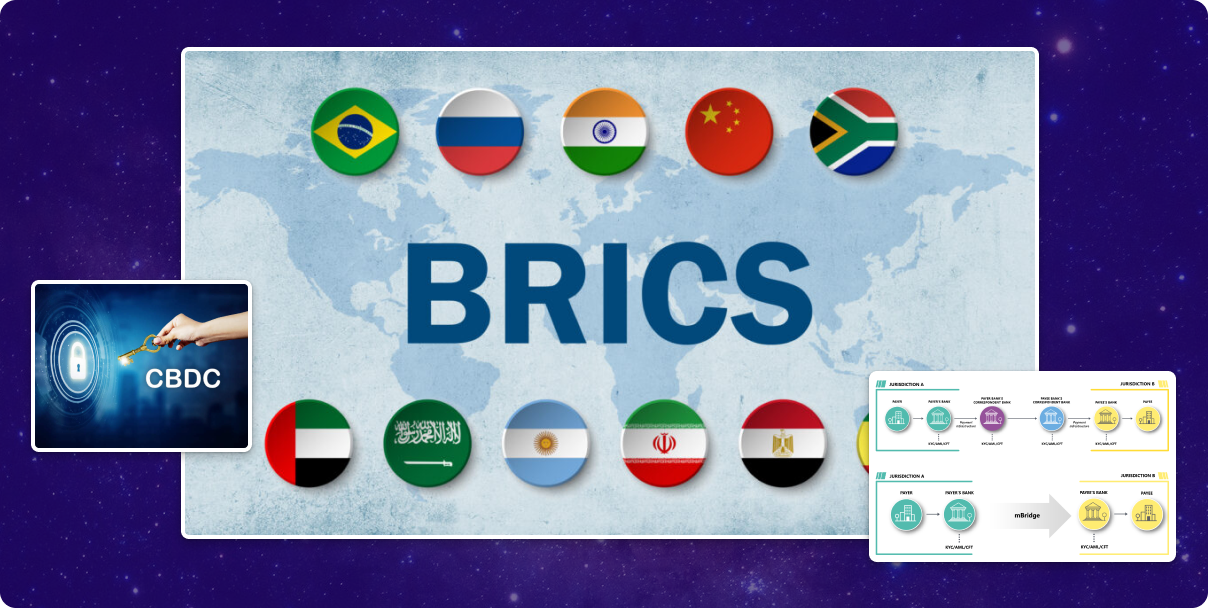
The transformation of international trade settlement is moving away from speculative single-currency replacements toward multi-bilateral technical interoperability.
Rather than attempting to launch a unified, centralized monetary unit, participating central banks are leveraging wholesale digital currency bridges, messaging integration (such as linking CIPS, UPI, and Pix), and payment-versus-payment (PvP) ledger mechanics to eliminate settlement friction.
By embedding compliance and sovereign capital controls directly into programmable infrastructure, these networks allow nations to mitigate foreign sanctions and exchange risks while preserving their monetary autonomy on the world stage.
Sanctions Shock and Alternative Settlement Rails
The transformation of the global financial architecture between 2014 and 2026 represents the most significant shift in international monetary relations since the collapse of the Bretton Woods system. The catalyst was not a scheduled multilateral agreement, but the systematic weaponization of Western financial infrastructure.
When the United States and its allies imposed sanctions following the 2014 annexation of Crimea and subsequently froze approximately $300 billion in Russian central bank reserves in 2022, non-G7 nations realized that holding dollar-denominated assets in Western custodian banks constituted an existential counterparty risk.
Threats to sever access to the Society for Worldwide Interbank Financial Telecommunication (SWIFT) transformed defensive risk mitigation into offensive architecture. Recognizing SWIFT as a jurisdictional tool rather than a neutral messaging protocol, key emerging powers constructed localized alternatives.
Russia launched the System for Transfer of Financial Messages (SPFS) in 2014 to insulate domestic banking traffic. Simultaneously, China accelerated the Cross-Border Interbank Payment System (CIPS), enabling direct clearing and settlement in Renminbi (RMB) while eliminating the requirement to route transactions through New York clearinghouses.
CIPS, SPFS, and mBridge
Rather than constructing a fragile, unified “BRICS Currency”—which would require a supranational central bank and shared fiscal policies that sovereign nations resist—the multi-polar alliance built an interconnected gateway model. This model relies on protocol abstraction. Systems like BRICS Pay act as an API translation layer connecting independent domestic frameworks, including India’s Unified Payments Interface (UPI), China’s CIPS, and Russia’s SPFS and Mir card networks.
At the wholesale level, Project mBridge exemplifies the technological frontier of this transition. Developed alongside participating central banks, mBridge operates on a custom distributed ledger technology (DLT) framework. It enables direct, peer-to-peer central bank digital currency (CBDC) transfers via atomic Payment-versus-Payment (PvP) settlement. By settling foreign exchange transactions simultaneously across shared ledgers, mBridge bypasses Western correspondent banking networks entirely, removing foreign exchange delivery risk and rendering New York clearinghouses blind to cross-border capital flows.
Despite these technological advances, friction points persist. Bilateral trade surges, such as India’s massive purchases of discounted Russian crude, created a “Rupee overhang”—where Russia accumulated billions in non-convertible rupees in Indian accounts. Furthermore, New Delhi’s reluctance to replace dollar hegemony with yuan dominance highlights ongoing geopolitical tensions within the bloc, prompting a reliance on multi-currency baskets, UAE Dirhams, and local swap lines.
Geopolitical Fragmentation and the Internal American Fracture
The acceleration of non-Western financial autonomy coincides with deep domestic institutional polarization within the United States. Foreign state strategists analyze this dynamic through the lens of Grey-Zone Warfare and Cognitive Domain Operations (CDO). Under doctrines like China’s Unrestricted Warfare, an adversary avoids direct blue-water naval engagements, focusing instead on exploiting social, political, and cultural fault lines to weaken the opponent from within.
By employing reflexive control—the strategic delivery of tailored information designed to induce an opponent to voluntarily make self-damaging decisions—external threat actors amplify internal political polarization. Continuous erosion of trust in intelligence agencies, judicial systems, and military command structures creates decision-making friction.
This domestic paralysis directly impacts global strategic deterrence. As the Pentagon tracks the 2027 “Davidson Window”—the threshold capability timeline for potential military intervention in the Taiwan Strait—internal political gridlock reduces the credibility of American political will. When executive command response times are delayed by political crises, adversaries calculate that economic, digital, and kinetic maneuvers carry significantly lower strategic risks.
Commodities and Sovereign Gold Reserves
As the security of foreign-hosted fiat debt liabilities diminishes, global central banks are executing a structural pivot toward unencumbered physical assets. Central banks across China, India, Turkey, and the Middle East have engaged in historic net purchases of physical gold bullion.
Crucial to this strategy is the operational distinction between paper gold claims and allocated physical bullion stored in domestic vaults. Paper claims traded on Western exchanges remain subject to hyper-hypothecation, exchange halts, and counterparty default during liquidity panics. Conversely, physical gold stored domestically represents an unencumbered, non-sanctionable asset with zero counterparty risk.
Parallel to central bank gold accumulation is the de-pegging of global energy and physical commodity clearing from the U.S. dollar. The expansion of petro-yuan contracts and local-currency energy corridors has shifted pricing power toward physical commodity producers.
Central bank reserve optimization models now explicitly factor in geopolitical seizure probabilities, systematically reducing allocation weights for G7 sovereign debt and increasing allocations toward gold, industrial metals, and physical commodity reserves.
Ultimately, the shift toward decentralized settlement infrastructure represents a pragmatic re-engineering of global trade channels—ensuring financial resilience through sovereign interoperability rather than ideological isolation.

Inside BRICS' New Digital Money System provides key insight into how CBDC bridges and emerging multi-currency payment networks operate outside traditional correspondent banking rails.

Help us grow by advertising your business in our newsletter and reaching an engaged community.
